







Archives
Feature, Freight News, Logistics, Sea
Shipping Emissions Fall as Fleet Grows, Drewry
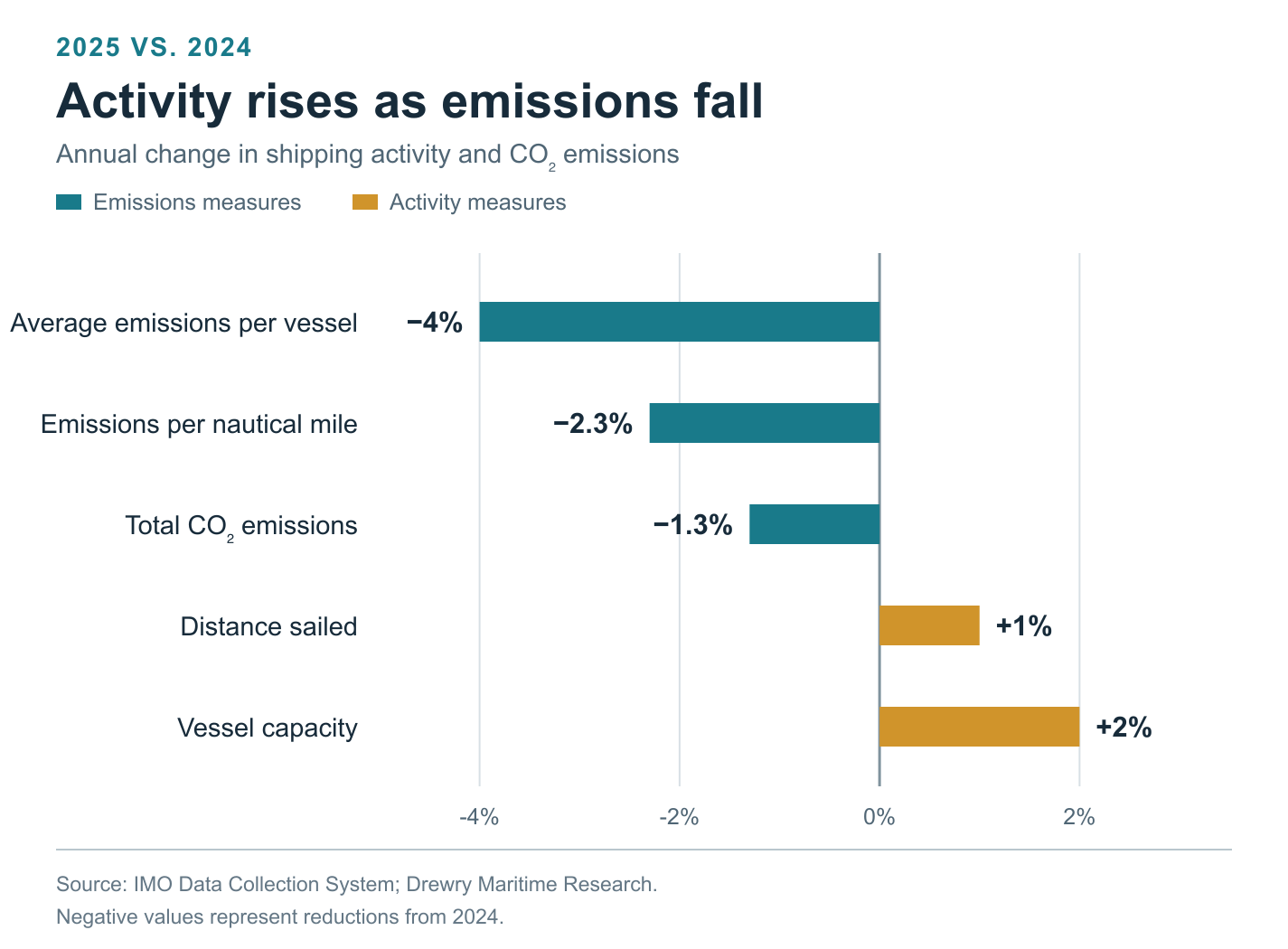
[ November 5, 2026 // Gary Burrows ]Global shipping reduced its carbon dioxide emissions by 1.3 percent in 2025 even as fleet capacity and sailing distances increased, according to Drewry’s analysis of verified data submitted to the International Maritime Organization.
Vessel capacity increased 2 percent during the year and the total distance sailed rose 1 percent. Average emissions per vessel nevertheless declined 4 percent, while emissions per nautical mile decreased 2.3 percent.
Drewry attributed the improvement partly to greater biofuel consumption and generally lower operating speeds. The industry recorded the reductions despite longer voyages around the Cape of Good Hope.
Shipping consumed approximately 221 million tonnes of fuel in 2025, including 18.3 million tonnes of alternative fuels. On an energy-equivalent basis, alternative fuels supplied 9.5 percent of shipping’s energy demand, compared with 5.9 percent in 2019.
Liquefied natural gas remained the dominant alternative fuel, with consumption holding just below 15 million tonnes. Biofuel consumption more than doubled to approximately 2.5 million tonnes, increasing its share of alternative-fuel demand to about 12 percent from 6.2 percent in 2024.
Methanol represented only 0.3 percent of alternative-fuel use on an energy basis, while ammonia has yet to appear as a separately reported fuel in the IMO Data Collection System.
The difference between vessel capability and fuel consumption remains significant. Orders for ships capable of using methanol, ammonia and LNG have expanded, but fuel cost, infrastructure and regulation continue to determine whether those capabilities are used.
Shipping’s supply-based carbon intensity, measured through the Annual Efficiency Ratio, improved another 1.6 percent in 2025. That left the industry 33.1 percent below its 2008 level.
Drewry said continuation of the same improvement rate would put the IMO’s target of reducing carbon intensity 40 percent by 2030 within reach. The firm cautioned that the progress remains incremental and does not represent the deeper fuel transition required to meet longer-term emissions targets.
The 2025 results also marked the third year of Carbon Intensity Indicator implementation. The share of vessels rated compliant increased 4 percent, while the portion that did not report a CII rating declined from 8.9 percent to 3.6 percent.
Performance varied among vessel sectors. The share of compliant LNG carriers declined 1.6 percent as changing trade patterns increased demand for less-efficient vessels. Container ships and tankers increased their average speeds despite the broader fleet slowdown, reflecting stronger demand, higher utilization and longer voyages.
The IMO’s Marine Environment Protection Committee is scheduled to consider the 2025 data at MEPC 85 from Nov. 30 through Dec. 3. A resumed extraordinary session scheduled for Dec. 4 could also reconsider amendments establishing the IMO Net-Zero Framework.
Drewry said a mechanism narrowing the cost gap between conventional and lower-emission fuels could determine whether shipping moves beyond operational efficiency gains toward more substantial emissions reductions.
Tags: Drewry, International Maritime Organization