drewry
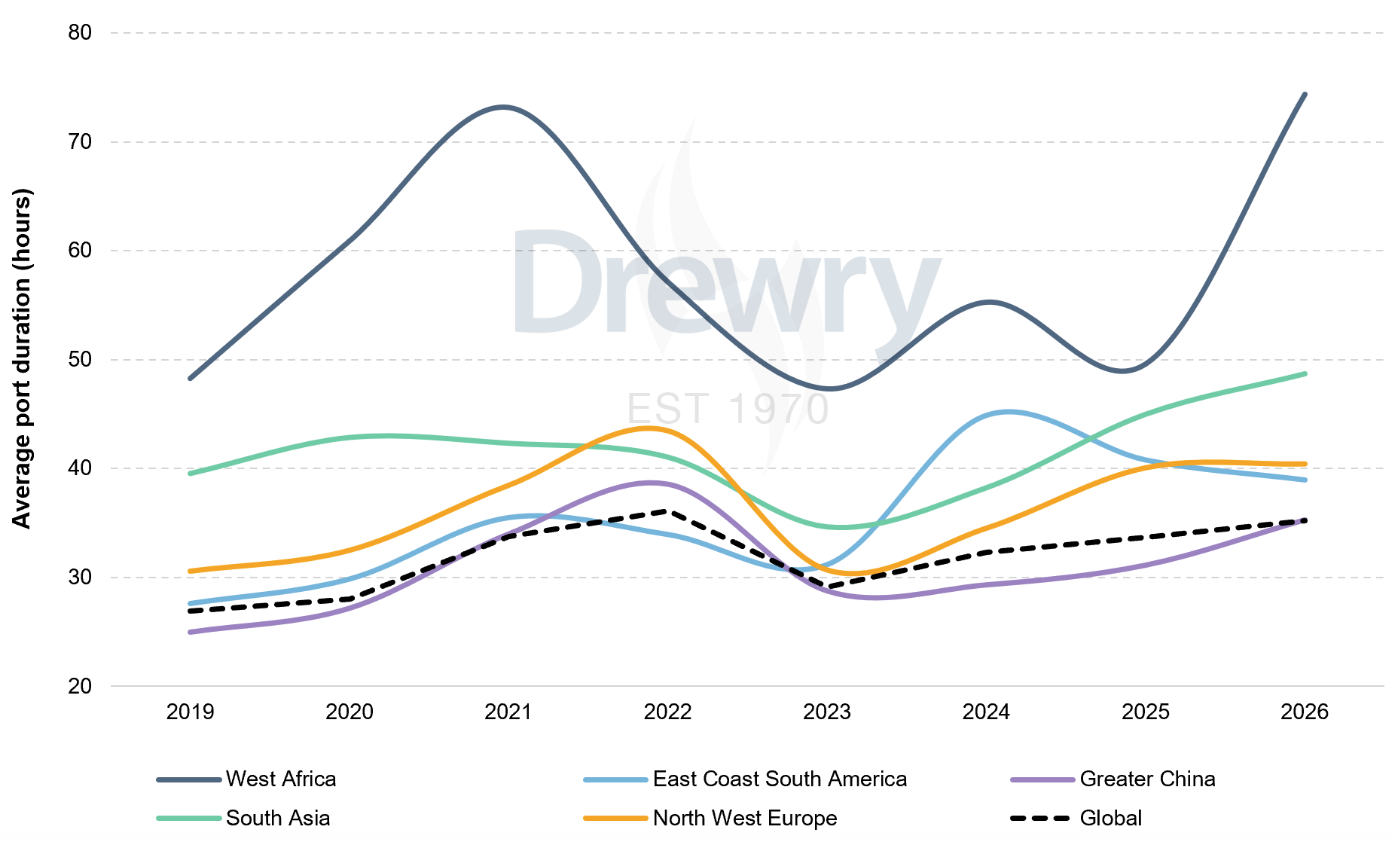
Worsening container port congestion is exposing a fundamental disagreement over what is causing it: too little investment in terminal capacity, or an industrywide drive for higher asset utilization that has left the supply chain with too little room for disruption.
A.P. Moller-Maersk CEO Vincent Clerc recently pointed to roughly 15 years of lagging terminal investment as container ships face congestion in several major trading regions. Drewry agrees that port congestion risk ...
[+]
Trans-Pacific container spot rates moved higher for a second week while Asia-Europe rates continued to retreat, as stronger-than-expected U.S. import demand and carrier capacity management increasingly separate the two major east-west markets.
Drewry's World Container Index rose 1 percent to US$4,339 per 40-foot container for the week of Aug. 13, driven ...
[+]

FBJNA’s Container Market Signals – Spot container freight rates showed their first broad signs of easing this week as early peak season demand moderated and carriers continued restoring capacity, according to weekly market updates from Drewry and Xeneta.
Both indexes reported declines on the major Asia-U.S. and Asia-Europe trades, suggesting the ...
[+]

Editor's Note by Gary Burrows for FBJNA's July-August issue, available soon
There was a time when the logistics decision was relatively straightforward.
The cargo was ready. Capacity was available. The rate was acceptable. The shipment moved.
Those decisions were never simple, but they were largely transportation decisions.
Increasingly, they are not.
Today, the questions come ...
[+]
EDITOR’S NOTE: Freight Business Journal North America’s Peak Season Forecast 2026 in the July-August issue brings together leading market analysts and logistics executives to examine whether the current freight rally has staying power, the indicators they are watching most closely, and what shippers should expect during the balance of the ...
[+]
Drewry is encouraging shippers and logistics providers to adopt a standardized bunker adjustment factor (BAF) policy as rising fuel costs and new environmental regulations add complexity to ocean freight pricing.
The maritime research and consulting firm said escalating geopolitical tensions in the Middle East have increased pressure on bunker fuel prices, ...
[+]

Global container shipping rates continued to rise across major benchmarks, but market signals from Drewry and Xeneta point to diverging dynamics between stable capacity on some lanes and tightening conditions driven by geopolitical disruption and congestion.
Drewry’s World Container Index for the week of March 19 increased 2 percent week over ...
[+]
Blank sailings are surging across major trade lanes, underscoring how schedule volatility is reshaping operational planning for ports and inland operators.
Data from maritime consultancy Drewry show a 122 percent month-over-month increase in blank sailings on key east-west routes in February, effectively doubling withdrawn capacity compared with the previous period.
While blank ...
[+]

Container shipping disruptions linked to tensions around the Strait of Hormuz are testing whether Gulf states can reroute cargo through alternative ports and inland corridors, but structural constraints limit short-term options, according to Drewry Maritime Research.
The chokepoint handles a relatively small share of global container volumes, about 3.5 percent, but ...
[+]
Blank sailings are surging across major trade lanes, underscoring how schedule volatility is reshaping operational planning for ports and inland operators.
Data from maritime consultancy Drewry show a 122 percent month-over-month increase in blank sailings on key east-west routes in February, effectively doubling withdrawn capacity compared with the previous period.
While blank ...
[+]
More »