








Archives
Feature, Freight News, Logistics, Sea
Drewry Challenges Cause of Port Congestion
[ August 28, 2026 // Gary Burrows ]Worsening container port congestion is exposing a fundamental disagreement over what is causing it: too little investment in terminal capacity, or an industrywide drive for higher asset utilization that has left the supply chain with too little room for disruption.
A.P. Moller-Maersk CEO Vincent Clerc recently pointed to roughly 15 years of lagging terminal investment as container ships face congestion in several major trading regions. Drewry agrees that port congestion risk is rising, but says the evidence does not support a simple global narrative of underinvestment.
Instead, Drewry argues that ports and ocean carriers have increasingly optimized their operations around cost, utilization and returns rather than resilience.
The consequences are becoming more visible.
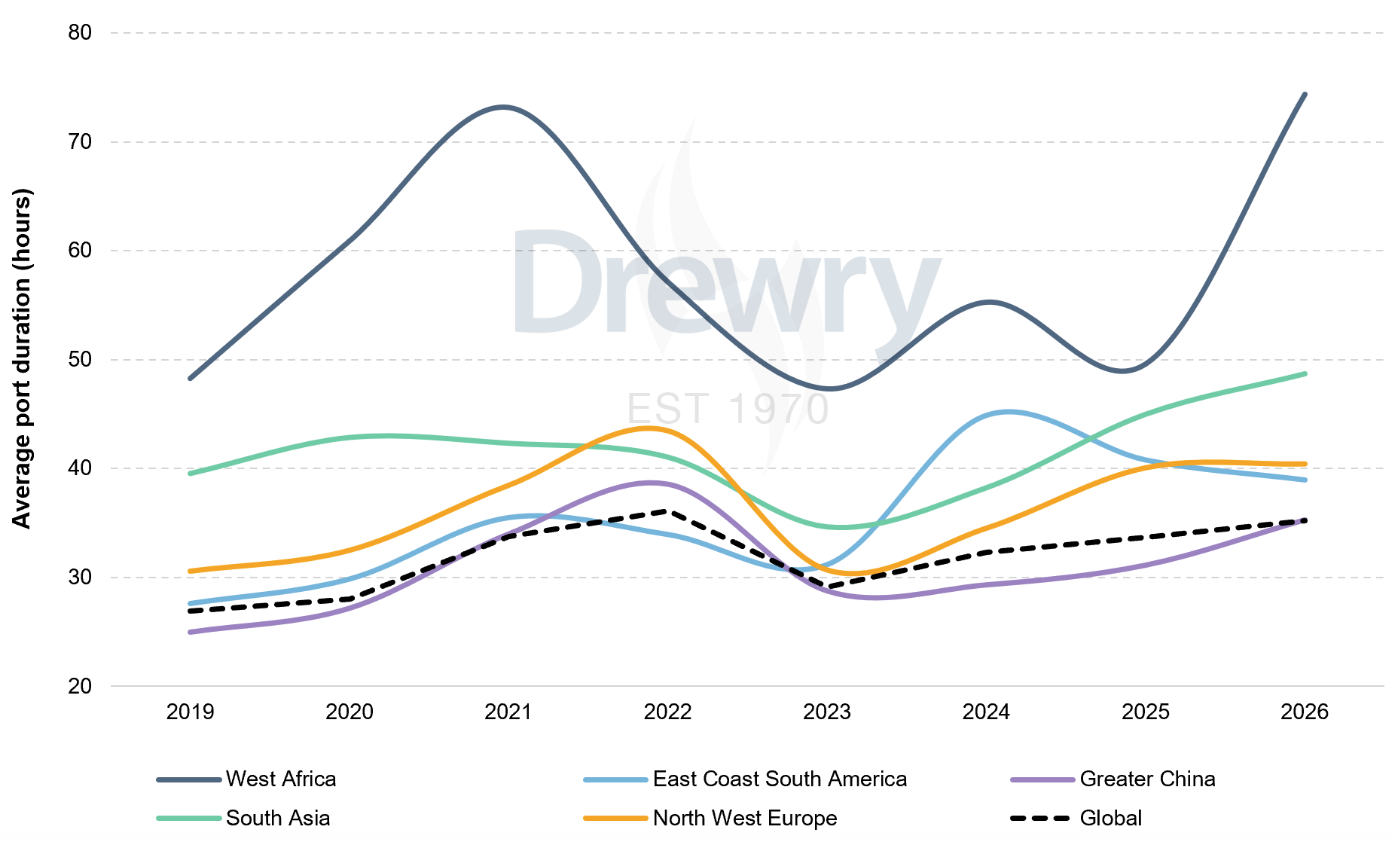
Global average containership waiting times nearly doubled between the first seven months of 2019 and the same period this year, according to Drewry. Average total time spent in port increased 31 percent, with a growing share of that time spent waiting for a berth rather than being worked at a terminal.
Weather can quickly expose the system’s vulnerability. Typhoons in China during early August pushed average berth waiting times to 3.6 days during week 32, according to Drewry’s Ports and Terminals Insight.
But Drewry’s analysis suggests the underlying problem is structural.
Speaking during Maersk’s Aug. 13 financial presentation, Clerc said container port capacity was insufficient and contributing to congestion in Europe, the East Coast of South America, West Africa and the Middle East amid strong container export growth from Asia.
“This growth and increasing trade imbalances comes on the heels of about 15 years since the financial crisis, where investment into terminal capacity has lagged,” Clerc said.
Drewry’s data provide some support for the capacity concern, but lead to a different conclusion.
Across nine major container ports examined by Drewry, terminal operators increased capacity by an average 21 percent between 2019 and 2026, while container volumes increased 28 percent.
The gap was not universal. Singapore expanded capacity slightly faster than volumes, while Shanghai, Santos, Jawaharlal Nehru Port and Qingdao did not.
At Santos, Drewry pointed to a combination of delays involving the STS10 concession, landside transportation constraints and particularly strong demand growth. In China and Europe, meanwhile, largely private-sector terminal operators have increased utilization while allowing capacity to grow more slowly than volumes.
That reflects an economic calculation rather than necessarily a failure to invest.
The tradeoff becomes apparent when disruption occurs.
Drewry estimates that a terminal operating at 90 percent berth utilization requires roughly one week to recover from a one-day disruption. A terminal operating at 75 percent utilization can recover in about two days.
Yet maintaining that additional unused capacity during normal conditions can mean the difference between a competitive and uncompetitive return on capital.
Drewry also argues that responsibility does not stop at the terminal gate.
Ocean carriers face many of the same incentives to maximize returns. Blank sailings, ad hoc sailings and extra loaders can create sharp peaks in vessel arrivals at major ports, contributing to yard congestion and berth delays.
That makes congestion less a question of whether ports alone have built enough capacity than of how the container shipping system uses the capacity it has.
Drewry therefore sees no single global trend toward port underinvestment. Instead, increasing asset utilization has reduced the industry’s ability to absorb weather disruptions, irregular vessel arrivals, rapid demand growth and landside transportation problems without creating queues.
Terminal operators are expected to continue adding capacity, but Drewry argues they cannot economically finance large amounts of unused “buffer capacity” by themselves.
The emerging debate therefore goes beyond whether the industry needs more berths and cranes. It is whether a container shipping system built to maximize efficiency and returns can also provide the resilience increasingly demanded of it.
Tags: A.P. Moller-Maersk, Drewry