







Archives
Feature, Freight News, Logistics, Sea
Trans-Pacific Rates Rally as Europe Peak Fades
[ August 13, 2026 // Gary Burrows ]Trans-Pacific container spot rates moved higher for a second week while Asia-Europe rates continued to retreat, as stronger-than-expected U.S. import demand and carrier capacity management increasingly separate the two major east-west markets.
Drewry’s World Container Index rose 1 percent to US$4,339 per 40-foot container for the week of Aug. 13, driven by increases on the Trans-Pacific.
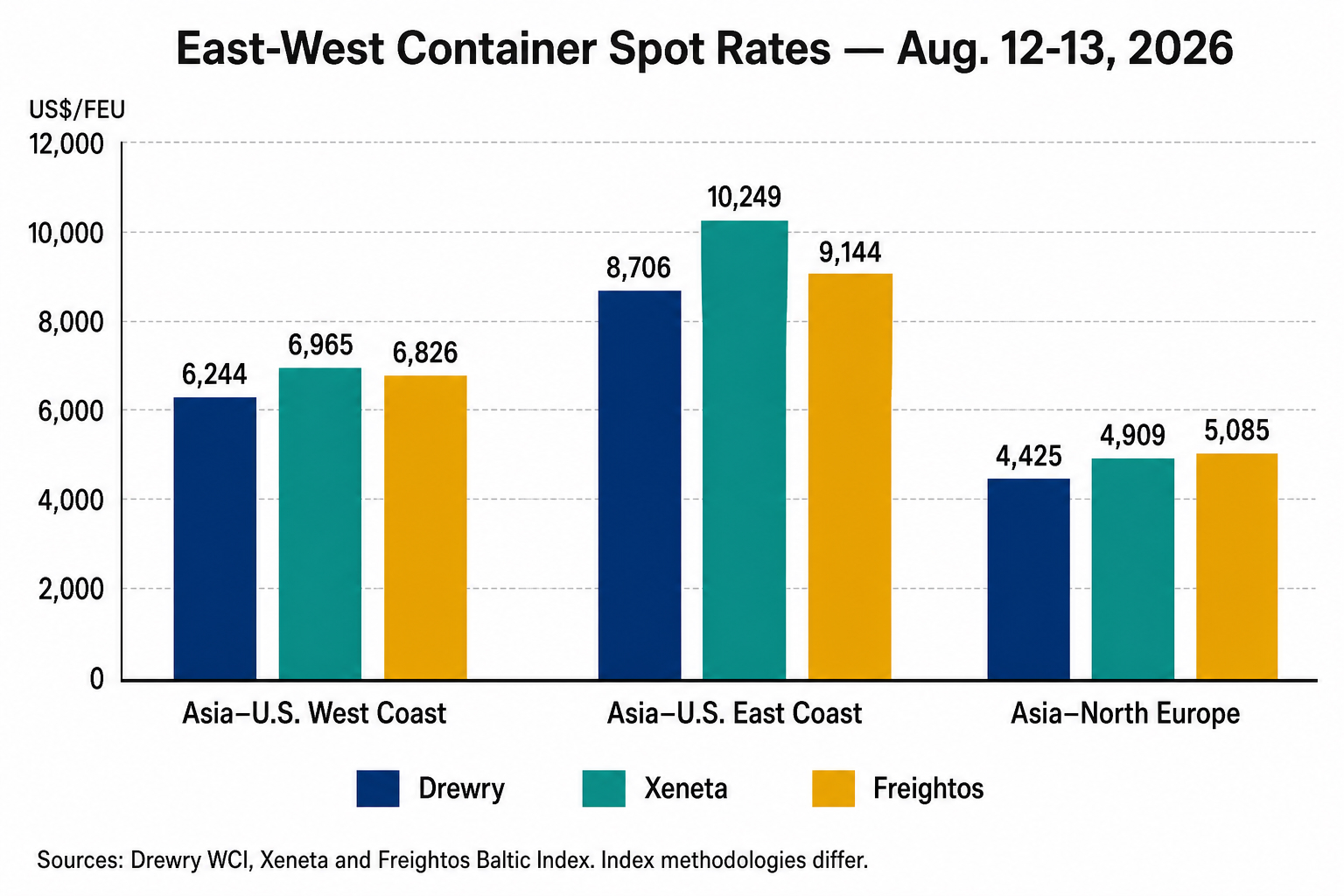
Drewry’s Shanghai-Los Angeles rate increased 6 percent to US$6,244 per 40-foot container, while Shanghai-New York jumped 10 percent to US$8,706.
Freightos reported the same direction, with its Asia-U.S. West Coast rate increasing 11 percent to US$6,826/FEU and the East Coast rate gaining 1 percent to US$9,144/FEU.
The Trans-Pacific strength contrasts with expectations earlier this summer that an early peak season driven partly by tariff frontloading would be followed by a pronounced decline in U.S. imports.
Freightos Head of Research Judah Levine noted that the National Retail Federation has revised its outlook toward more sustained, elevated import demand through September. He said some shippers that frontloaded ahead of the July tariff deadline may have extended orders after a sharp increase in duties failed to materialize, while others that had delayed orders amid economic uncertainty may be responding to continued consumer spending strength.
Carriers are also restricting Trans-Pacific capacity. Drewry said 10 sailings were canceled in each of the past two weeks, with another seven cancellations planned for next week.
Asia-Europe is moving in the opposite direction as its early peak season loses momentum.
Drewry’s Shanghai-Rotterdam rate fell 5 percent to US$4,425/FEU, while Shanghai-Genoa dropped 8 percent to US$5,080. Freightos recorded similar declines, with Asia-North Europe down 8 percent to US$5,085/FEU and Asia-Mediterranean down 7 percent to US$6,067.
Freightos said Asia-Europe rates have fallen about US$1,000/FEU, or 15 percent, from early July highs as carriers cancel or reduce planned mid-August rate increases and add blank sailings. Rates nevertheless remain about US$2,000 above mid-May levels.
While spot-market trends are diverging, Xeneta said the effects of months of Middle East disruption are increasingly reaching the long-term contract market.
Since Feb. 28, Xeneta’s average long-term rates have increased 41 percent from the Far East to the U.S. West Coast, 40 percent to the U.S. East Coast and 41 percent to North Europe. Far East-Mediterranean contract rates have risen 17 percent.
“The disruption caused by war in the Middle East is becoming a deepset and structural problem that will not go away any time soon,” Xeneta Chief Analyst Peter Sand said.
On the Far East-U.S. West Coast trade, Xeneta’s average spot rate now stands US$4,103/FEU above its long-term rate, reversing the relationship that existed before the Middle East crisis.
Sand said the widening spread is strengthening carriers’ negotiating position in contract talks and advised shippers against locking themselves into yearlong agreements while the market is rising.
Tags: Drewry, Freightos, Xeneta