








Archives
Freight News, Logistics, Sea
Capacity Growth Tilts Towards Buyers in 2027
[ November 13, 2026 // Gary Burrows ]FBJNA MARKET SIGNALS — Freight markets are moving toward greater capacity and softer pricing in 2027, but the outlook is not as simple as supply overtaking demand.
Xeneta expects containership capacity to grow faster than cargo demand next year, while Freightos’ Nov. 10 data showed ocean rates beginning to ease. Continued disruption through the Middle East, poor schedule reliability and carriers’ capacity-management decisions could nevertheless prevent a smooth return to a buyers’ market.
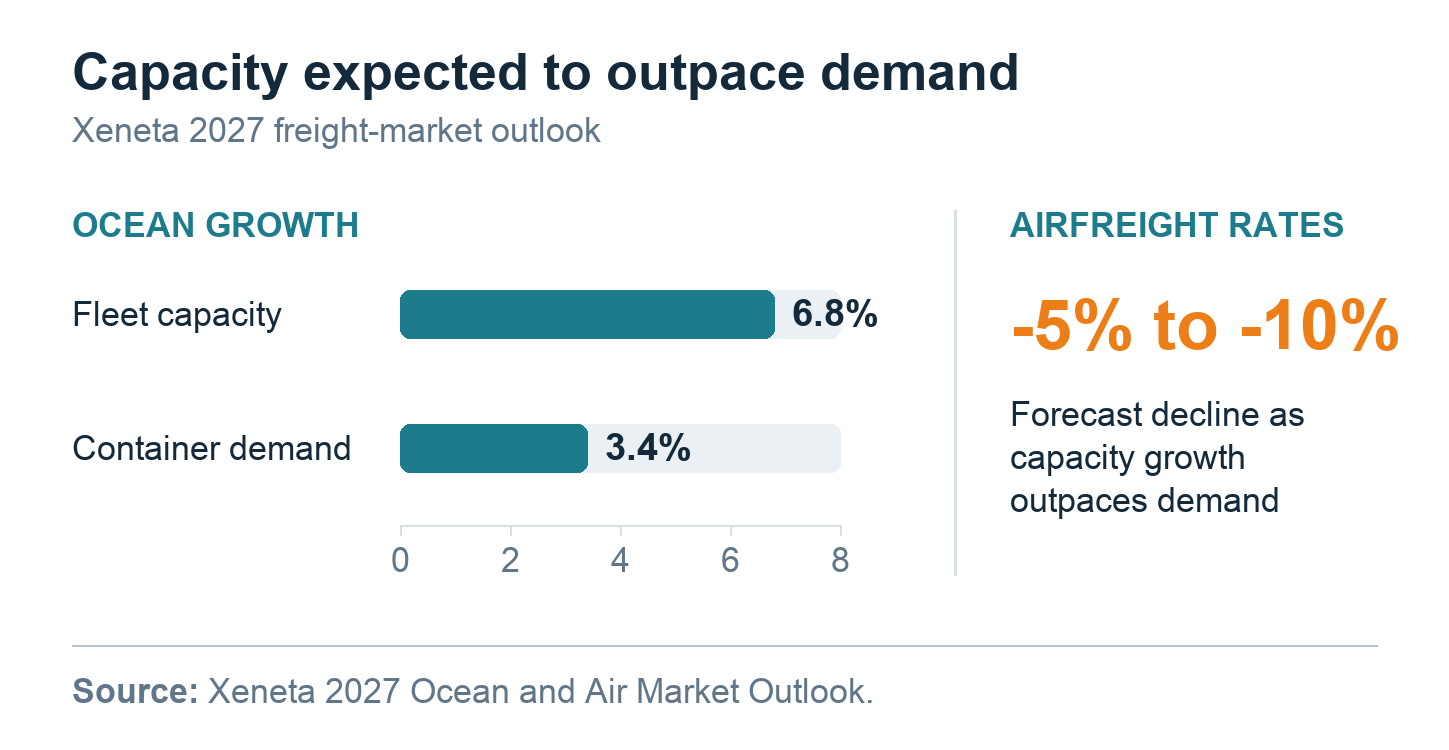
Ocean Fleet Outruns Demand. Xeneta forecasts global container volume growth of about 3.4 percent in 2027, within a range of 2.5 percent to 4 percent. That compares with expected fleet growth of 6.8 percent as carriers absorb deliveries from a record orderbook totaling 15.5 million TEUs.
The imbalance points toward downward pressure on freight rates and stronger negotiating leverage for shippers. Accelerated vessel demolition is not expected to offset the incoming capacity.
The demand picture also remains uneven. Global container volumes increased 4.7 percent during the first eight months of 2026, but Xeneta attributed much of the growth to frontloading rather than underlying consumption. Fronthaul volumes were 38 percent higher than in 2019, while backhaul volumes remained 9 percent lower.
Capacity growth also will differ among carriers. Xeneta expects MSC and CMA CGM to receive the largest shares of 2027 deliveries. Hapag-Lloyd’s fleet position will depend partly on its planned acquisition of ZIM, while HMM and Yang Ming are expected to record relatively little growth.
Suez Return Adds Effective Capacity. The return to the Suez Canal is reinforcing the fleet-growth signal by releasing capacity that had been absorbed by longer Cape of Good Hope routings. BIMCO estimated those diversions increased containership demand by about 10 percent.
Canal capacity averaged 753,000 TEUs a week during the first two weeks of October, exceeding half of its pre-Red Sea disruption level for the first time since Houthi attacks began. Drewry subsequently estimated that 60 percent of Asia-Europe capacity was using the canal by early November.
BIMCO Chief Shipping Analyst Niels Rasmussen expects the adjustment to unfold gradually. Carriers can add large owned or long-term-chartered ships to existing rotations and reduce speeds, but further cascading appears likely as 123 ships larger than 12,000 TEUs are scheduled for delivery during 2026 and 2027. Smaller chartered ships could then be returned to owners, weakening time-charter markets before the full pressure reaches freight rates.
Carriers may eventually use lower charter costs to expand networks and capacity. The transition could therefore produce selective rate pressure, additional blank sailings and increased vessel idling rather than a smooth, immediate decline.
Spot Rates Edge Lower. Freightos said proposed rate increases again failed to hold in early November. Its index placed Asia-U.S. West Coast rates at US$8,245 per FEU, down 1 percent for the week, and East Coast rates at US$9,708, down 2 percent. Both remained near peak-season levels.
Asia-Europe rates also weakened. Freightos measured US$3,422 per FEU to Northern Europe and US$4,324 to the Mediterranean, down 5 percent and 1 percent for the week but still 50 percent and 88 percent above year-earlier levels, respectively.
Drewry’s World Container Index declined 2 percent to US$4,305 per 40-foot container on Nov. 12. Shanghai-New York rates fell 3 percent to US$9,020, their lowest since August, while Shanghai-Los Angeles dropped 2 percent to US$7,416, its lowest since September. Shanghai-Rotterdam decreased 3 percent to US$3,504, while Shanghai-Genoa held at US$4,168. Drewry expects transpacific rates to decline further as weak demand outweighs additional blank sailings, although capacity reductions and higher surcharges could provide modest support on Asia-Europe routes.
The signals support the 2027 supply outlook without promising an orderly decline. Transpacific and Asia-Europe rates remain elevated even as weekly prices soften.
Reliability Remains the Counterweight. Xeneta measured global on-time arrivals at 24 percent in October, down 3 percentage points from September and the lowest monthly average since July 2022. Average delay increased 0.4 day to 6.4 days. Far East-Europe reliability improved to 7 percent from 4 percent, but its nine-day average delay left the trade close to the bottom of the rankings. Far East-North America remained at 19 percent on time with a 6.3-day average delay. Xeneta said easing vessel queues have not produced a comparable recovery in schedules, indicating that effective capacity remains constrained by accumulated terminal and network delays.
Xeneta advised shippers negotiating 2027 contracts to retain alternative routings and include provisions addressing service changes. Published transit times should be treated as best-case assumptions rather than firm operating plans.
Tags: Drewry, Freightos, Market Signals, Xeneta