






Archives
Feature, Freight News, Logistics, People, Sea
The Decision Before the Shipment
[ July 10, 2026 // Gary Burrows ]Editor’s Note by Gary Burrows for FBJNA’s July-August issue, available soon
There was a time when the logistics decision was relatively straightforward.
The cargo was ready. Capacity was available. The rate was acceptable. The shipment moved.
Those decisions were never simple, but they were largely transportation decisions.
Increasingly, they are not.
Today, the questions come before the shipment:
• What tariff will apply when the cargo arrives?
• Will the Strait of Hormuz still be operating normally?
• Is war-risk insurance available, and at what cost?
• Will carriers maintain capacity discipline?
• Has consumer demand changed?
• Should inventory move now…or wait?
The shipment hasn’t moved an inch.
Yet every one of those questions must be answered before a purchase order becomes a shipment. The decision has become far more complicated than arranging its transportation.
That realization became the organizing principle behind the July-August issue of Freight Business Journal North America.
Our cover story examines commercial shipping after the reopening of the Strait of Hormuz. While vessel traffic has resumed, confidence has not returned at the same pace. Carriers continue exercising caution. Insurers continue evaluating every voyage individually. Operators continue planning around uncertainty rather than certainty.
On page 2, you’ll find Market Signals, a new department we hope becomes a regular stop in every issue. Freight indexes from Xeneta, Drewry and Freightos don’t tell us what will happen next, but they often reveal how the market is responding before broader trends become obvious. Read together, they tell a story that no single index can tell on its own.
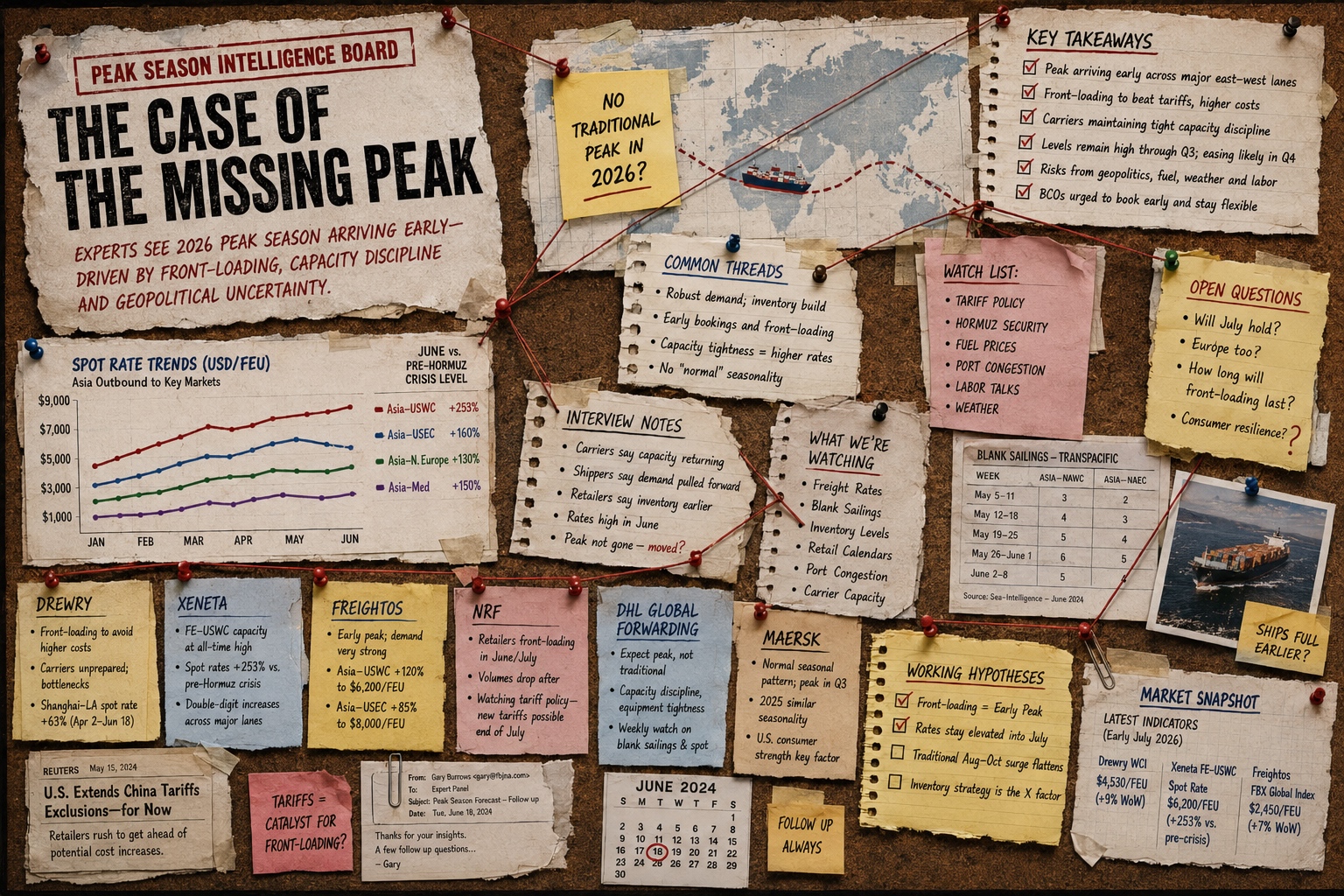
Later in the issue, our Peak Season Forecast asks another question (page 10). Not whether there will be a peak season – that answer has become increasingly complex – but what kind of peak season emerges when tariffs, inventory strategy, geopolitical risk, consumer demand and carrier discipline all influence the same shipping decision.
Individually, these are separate stories.
Collectively, they describe an industry undergoing a fundamental shift.
For much of my career covering international transportation, complexity usually meant execution.
Could the cargo make the sailing? Would congestion delay the shipment? Had customs paperwork been completed? Were there enough chassis, enough containers, enough drivers?
Those questions haven’t disappeared. In many ways, the industry has become remarkably good at answering them. Technology provides greater visibility than ever before. Ports move more cargo with greater efficiency. Carriers deploy increasingly sophisticated networks. Supply chains have become faster, more connected and more transparent.
Yet as operational complexity has become more manageable, strategic complexity has increased.
Today, a perfectly planned shipment can be overtaken by a tariff announcement. A vessel sailing on schedule can find itself operating in a conflict zone. An inventory decision made six months ago may be reshaped by a political decision made six days ago.
That doesn’t diminish the importance of execution.
It changes where competitive advantage is created.
The companies best positioned for the years ahead may not be those that simply move freight more efficiently. They may be the organizations that make better decisions before freight begins moving. They recognize patterns earlier, weigh competing risks more effectively and understand that today’s transportation decision increasingly carries financial, geopolitical and strategic consequences well beyond the loading dock.
Perhaps that explains why logistics now occupies a different place inside many organizations.
Not long ago, the industry’s challenge was earning a seat in the boardroom. Today, logistics shares that table with finance, procurement, legal, compliance, cybersecurity and risk management because every significant shipment has become a business decision before it becomes a transportation decision.
Perhaps that’s the defining characteristic of modern logistics.
The industry still moves freight. Ships still sail. Aircraft still depart. Trucks still roll. But the value increasingly lies not in executing movement, but in making better decisions before movement begins.
That’s why we organized this issue the way we did.
Not around modes of transportation.
Not around regions of the world.
Not around the biggest headlines.
But around the decisions shaping them all.
Because the most important question in logistics may no longer be, How do we ship it?
It may simply be:
Should we ship it now?
Tags: BIMCO, DHL, Drewry, Freightos, National Retail Federation, Port of Long Beach, Port of New York and New Jersey, Xeneta