








Archives
Feature, Freight News, Logistics, People, Rail, Road, Sea
USMCA Enters New Era as Tariffs Reshape Trade
[ July 10, 2026 // Gary Burrows ]Five years after the United States-Mexico-Canada Agreement took effect, the trade pact has entered a new phase. What began as a replacement for the North American Free Trade Agreement has become the framework underpinning North American manufacturing and freight movement just as tariffs, industrial policy and supply chain diversification are reshaping global trade.
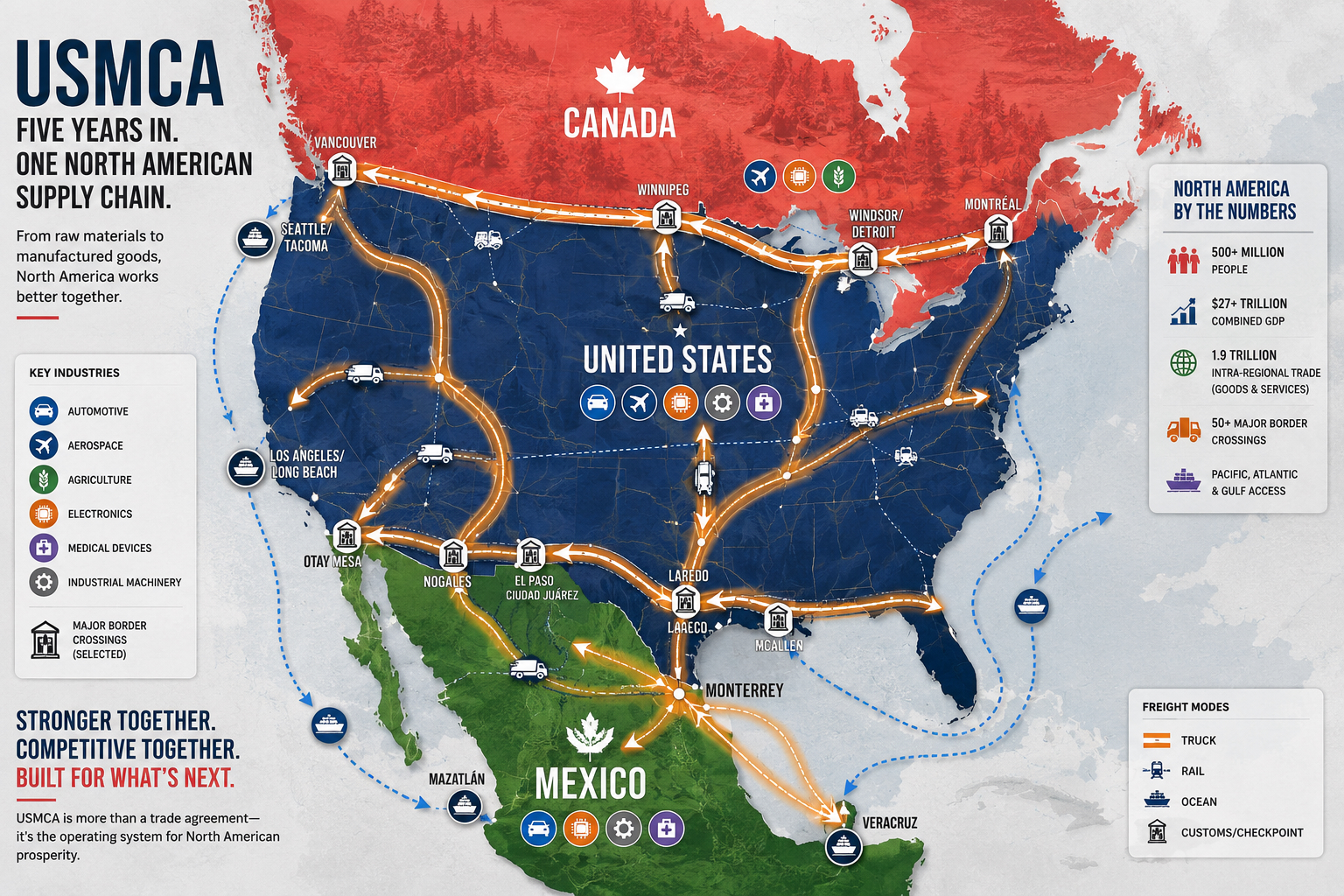
The timing is significant. As importers accelerate shipments ahead of potential tariff changes and manufacturers continue shifting production closer to North American consumers, USMCA has become more than a trade agreement. For carriers, ports, logistics providers and customs brokers, it increasingly serves as the operating system for an integrated continental supply chain.
That evolution is occurring against a backdrop few anticipated when the agreement entered into force on July 1, 2020. Rather than simply increasing trade among the U.S., Canada and Mexico, USMCA has become a critical component of the region’s response to geopolitical uncertainty, supply chain disruption and the renewed use of tariffs as a trade policy tool.
The agreement modernized NAFTA with updated provisions covering automotive rules of origin, digital trade, labor standards, intellectual property protections and customs administration. While implementation coincided with the Covid-19 pandemic, the years that followed accelerated trends that continue to reshape freight transportation.
Manufacturers began reassessing global sourcing strategies as pandemic-related disruptions exposed vulnerabilities in long, overseas supply chains. More recently, tariff uncertainty and growing geopolitical tensions have reinforced the push toward regional production. Companies are increasingly weighing resilience alongside cost when determining where to build products and source components.
For the freight industry, the result has been a steady transformation of North American cargo flows.
Rather than functioning as three distinct national markets, the U.S., Canada and Mexico increasingly operate as a single manufacturing ecosystem. Automotive parts, electronics, aerospace components, industrial machinery and consumer products routinely cross borders multiple times before reaching their final destination. That evolution has elevated the strategic importance of cross-border trucking, rail intermodal services, customs brokerage and inland logistics hubs.
Border gateways such as Laredo, Detroit-Windsor and key crossings in Arizona, California and Texas have become critical links in production networks that depend on reliable customs processing and predictable transit times. Delays measured in hours can ripple through manufacturing schedules built around just-in-time inventory management.
The agreement has also helped reduce friction through expanded digital trade provisions, streamlined customs procedures and closer regulatory cooperation among the three countries. While implementation remains uneven in some areas, logistics providers generally cite improved predictability compared with the framework it replaced.
At the same time, tariffs have complicated the operating environment.
Importers have continued to front-load shipments ahead of anticipated policy changes while manufacturers reassess supplier relationships and regional sourcing strategies. Rather than abandoning globalization, many companies are adopting a regionalized approach that balances overseas production with expanded manufacturing capacity in North America.
Mexico has emerged as a major beneficiary of that shift, attracting investment in automotive manufacturing, electronics, industrial parks and distribution facilities. Canada continues to play a vital role in integrated automotive, energy, agriculture and advanced manufacturing supply chains that support production throughout the continent.
The implications extend across every freight mode. Railroads have expanded cross-border intermodal offerings. Ports on the Gulf Coast and Pacific Coast continue positioning themselves to support evolving trade patterns. Third-party logistics providers are investing in customs expertise, warehousing and transportation management as customers seek greater visibility across increasingly complex continental supply chains.
Uncertainty, however, remains a defining feature of the market. Future tariff actions, periodic USMCA reviews, labor enforcement provisions and evolving rules of origin continue influencing investment decisions throughout North America.
Five years after replacing NAFTA, USMCA’s greatest significance may be less about the agreement itself than the environment in which it now operates. As companies adapt to a world defined by shifting trade policy, geopolitical risk and supply chain resilience, the agreement has become an increasingly important foundation for continental commerce.
For freight transportation, that means the next chapter of USMCA will likely be measured not simply by trade volumes, but by how effectively it supports the integrated North American supply chains on which shippers, carriers and logistics providers increasingly depend.
Tags: U.S.-Mexico-Canada Agreement