







Archives
Feature, Freight News, Logistics, Sea
US Grain Exports Grow 9% Despite China Tariffs
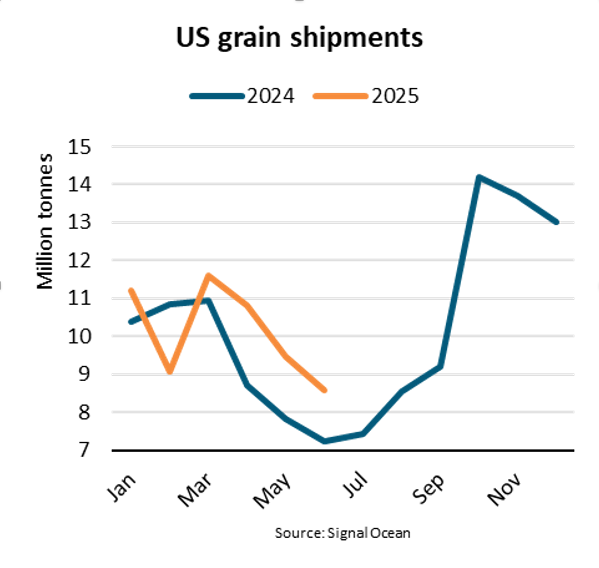
[ August 7, 2025 // Gary Burrows ]U.S. seaborne grain shipments improved 9 percent in the first half of 2025, despite retaliatory tariffs that caused U.S. grain exports to China to plummet 57 percent in the same period, said BIMCO, the Danish shipping association.
The first half result was driven by stronger maize exports, said Filipe Gouveia, shipping analysis manager at BIMCO.
In March 2025, China introduced higher tariffs on U.S. grain shipments, significantly reducing the competitiveness of U.S. cargoes. As a result, the share of China-bound U.S. grain cargoes plunged from 26 percent in the first half of 2024 to just 10 percent in 2025. To compensate for the decline, the U.S. increased shipments to other markets in Asia, Latin America and the Mediterranean.
Still, the shift in markets did not fully offset losses in certain commodities. U.S. soya bean exports fell 10 percent year-over-year, and sorghum exports 89 percent, as China remains a dominant player in these trades. Notably, 67 percent of global soya bean shipments and 84 percent of sorghum shipments are destined for China. By contrast, China accounts for a much smaller share of global wheat (7 percent) and maize (5 percent) shipments.
“While the increase in volume was a positive for the dry bulk sector during the first half of 2025, tonne-mile demand still fell 7 percent year-over-year, due to a 14 percent decrease in average sailing distances,” Giouveia said. “The new destinations for U.S. grains are on average closer to the U.S. than China.Additionally, the recovery of U.S. grain shipments via the Panama Canal further shortened distances.”
So far this year, 46 percent of U.S. grain cargoes have been transported by Panamax ships, 32 percent by supramax ships, and 22 percent by handysize ships. Tonne-mile demand increased for the panamax and handysize segments, supported by rising cargo volumes. However, the supramax segment saw a 33 percent decline in tonne-mile demand, as it faced stiff competition from panamax vessels in key markets like Japan and China, the two largest importers of U.S. grains.
The U.S. will be entering the harvesting season for grains in the coming months, and the Agriculture Department projects a 6 percent increase in maize production, while wheat and soya bean production are expected to see marginal declines.
“Tighter global supplies of wheat and maize could help sustain shipments. However, finding alternative markets for soya beans and sorghum may remain a challenge. For soya beans, in particular, China is expected to continue favoring Brazilian cargoes, bolstered by Brazil’s growing production,” Gouveia said.
Tags: BIMCO