







Archives
Feature, Freight News, Sea
Suez Transits Remain Down Despite No Attacks
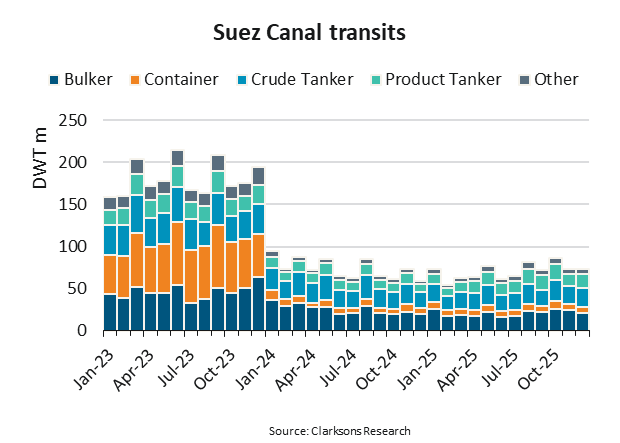
[ January 16, 2026 // Gary Burrows ]Though Houthis rebels declared an end to their attacks on ships transiting the Suez Canal on Nov. 18, traffic has not significantly increased, said Niels Rasmussen, chief shipping analyst at BIMCO.
Traffic for the first week of 2026 tracked 60 percent below the corresponding week in 2023, when ships began diverting around the Cape of Good Hope, he said.
Lloyd’s List said the Houthis have been 99 attacks or hijacking of ships since November 2023. Though 15 ships were attacked in November-December 2023, Suez Canal transits only began to see significant reductions in January 2024, and quarterly deadweight-tonne capacity transits have trailed 51 percent to 64 percent from 2023.
“In the fourth quarter, transits by bulkers, container ships, crude and product tankers were respectively: 55 percent, 86 percent, 32 percent and 19 percent lower than in 2023, he said.
Reduced Suez Canal transits remained stable for most shipping sectors in 2025, though product tankers have increasingly made Suez transits, taking advantage of increasing freight rate premiums. Thus, fourth quarter 2025 transits were only 19 percent lower than in 2023 compared to a 45 percent reduction during 2024.
Though nearly all container ships have avoided the canal since the attacks began, CMA CGM recently said its MEDEX and INDAMEX services were returning to Suez Canal routings in January.
Additionally, on Dec. 19, the Maersk Sebarok became Maersk’s first ship to transit the canal since early 2024, though the container has not announced any further transits. Assuming security thresholds continue to be met, Maersk said it would continue a “stepwise approach” to resuming navigation via the Suez Canal and the Red Sea.
BIMCO said recent reductions in Red Sea war risk premiums may encourage more ships to revert to Suez Canal routings. In early December, S&P Global said premiums fell to 0.2 percent of hull values, the lowest since November 2023 and down from 0.5 percent before the Israel-Hamas ceasefire.
“A return to the Suez Canal would reduce shipping companies’ costs significantly but also hurt ship demand,” Rasmussen said. Full normalization would reduce container ship demand by about 10 percent, while other sectors could see reductions of 2 percent to 3 percent, he added.
Tags: BIMCO, CMA CGM, Maersk, Suez Canal