








Archives
Feature, Freight News, IT Suppliers, Logistics, Sea
Ocean Reliability Slips on Key Trades, WiseTech
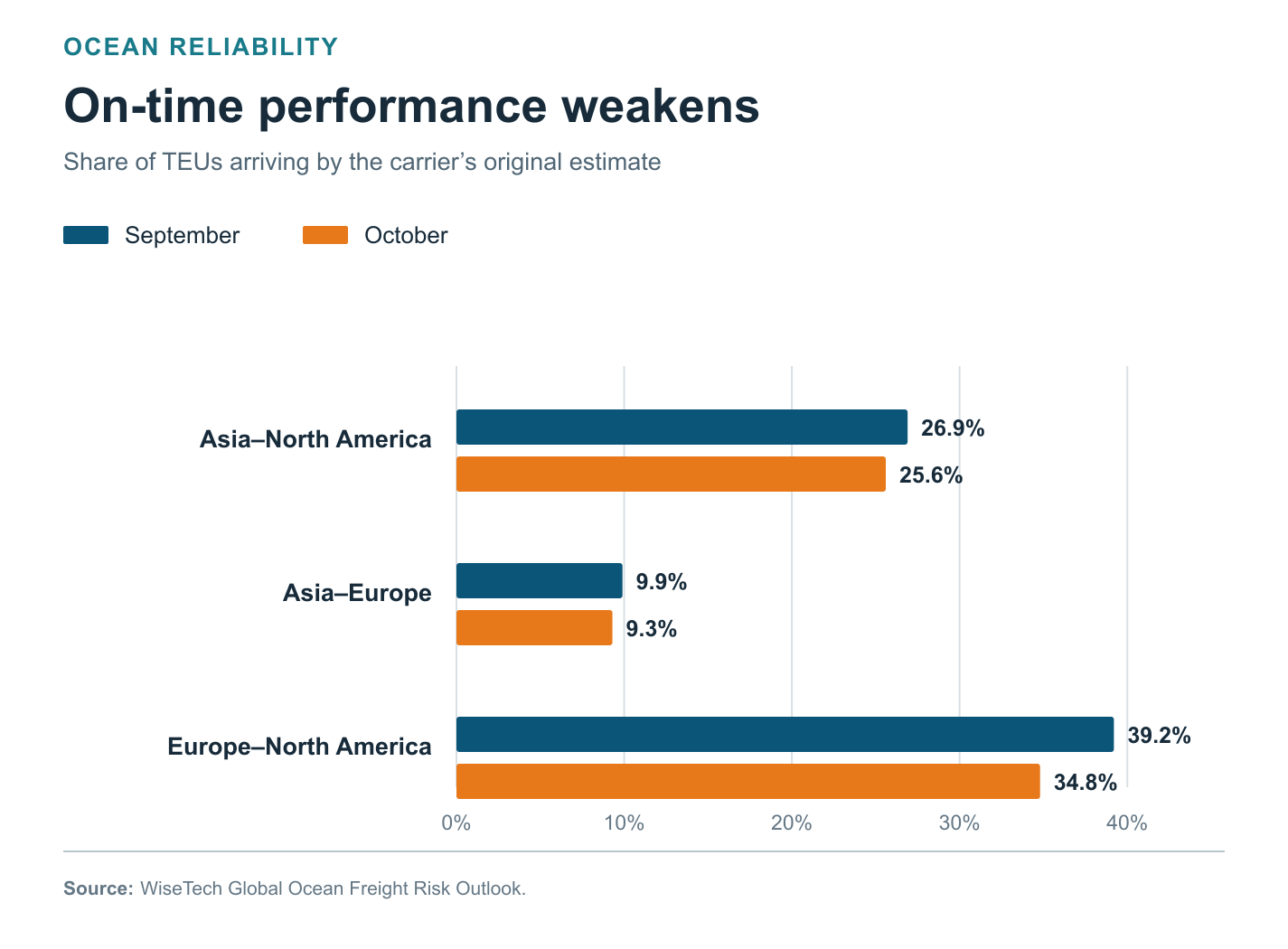
[ November 13, 2026 // Gary Burrows ]Ocean container reliability weakened across three major east-west trade lanes in October, while shorter published schedules did not consistently produce more predictable shipment times, according to WiseTech Global’s November Ocean Freight Risk Outlook.
The four-week forecast identifies the greatest capacity pressure on Asia–North America during weeks 47 and 48. WiseTech attributed the constraint to reduced planned carrier capacity rather than stronger demand. Booking Security Risk also remains above its historical average, indicating continued difficulty securing space on preferred sailings.
Monthly on-time performance fell from 26.9 percent in September to 25.6 percent in October. The latest weekly reading improved to 27.3 percent, but arrivals delayed by eight days or longer remained the largest outcome category. Actual transit-time reliability declined six percentage points to 21 percent.
Asia–Europe presents a different problem. Capacity pressure is expected to ease as demand softens and planned carrier capacity increases, but service reliability remains particularly weak. On-time performance fell from 9.9 percent in September to 9.3 percent in October and reached 6.5 percent in the latest weekly reading. Shipments delayed eight days or longer represented 39.1 percent of volume during that week.
Even the strongest-performing carrier among the 10 measured recorded an October on-time rate below 23 percent, limiting the ability of shippers and forwarders to manage delays through carrier selection alone.
Europe–North America remained the most stable trade for capacity and booking acceptance, although service performance deteriorated. On-time arrivals declined from 39.2 percent in September to 34.8 percent in October, while the latest weekly reading fell to 24.6 percent. October carrier results ranged from about 10 percent to 71 percent, giving shippers greater opportunity to reduce risk through carrier selection.
The outlook combines carrier schedules, forecast demand and supply, booking responses, container-tracking events, automatic identification system data and port-operating indicators. WiseTech defines an on-time shipment as one arriving at the port of discharge on or before the carrier’s original estimated arrival date.
The company declined to disclose the number of TEUs or booking requests underlying the outlook, citing commercial sensitivity. It said the model draws on a representative sample from a network serving more than 20,000 logistics companies and other participants across 193 countries. The latest observed mean absolute percentage error for its demand forecast ranges from 2 percent to 5 percent across the six directional trade lanes measured.
Tags: WiseTech