







Archives
Feature, Freight News, Logistics, Sea
Mediterranean Rates Defy Wider Market Decline
[ November 25, 2026 // Gary Burrows ]Container spot rates from Asia to the Mediterranean increased sharply during the week ending Nov. 19, moving against a broader decline across major east-west trades as the return of services to the Red Sea slowed.
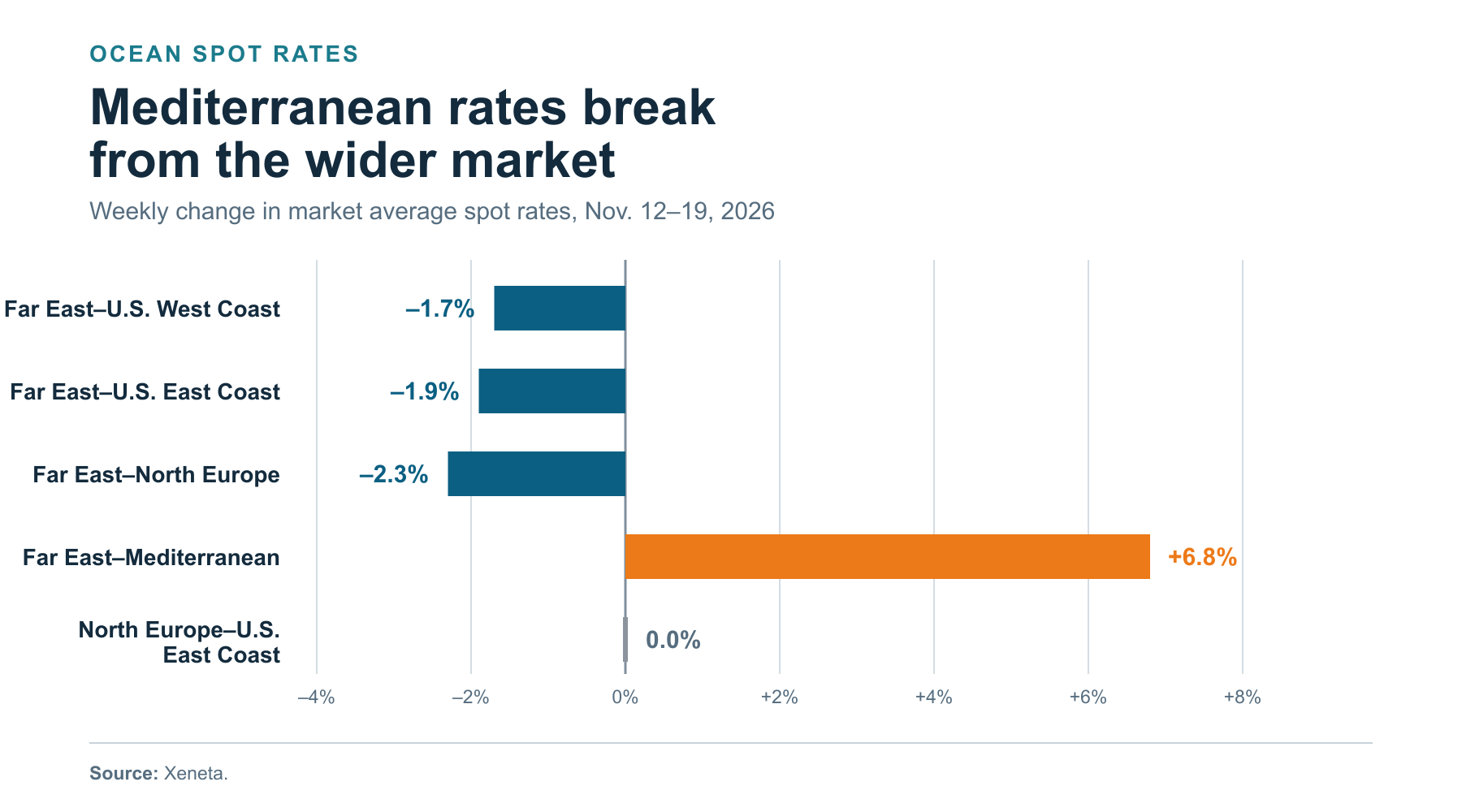
Xeneta reported a 6.8 percent weekly increase in Far East-Mediterranean rates to US$4,989 per 40-foot container. Its Mediterranean benchmark stood US$1,551 above Far East-North Europe rates, which declined 2.3 percent to US$3,438.
Freightos recorded an even larger weekly Mediterranean increase. Its Freightos Baltic Index rose 20 percent to US$5,162 per 40-foot container, with daily market readings subsequently adding about US$300.
The two indexes draw from different datasets and measurement periods and are not directly interchangeable. Both, however, show Mediterranean pricing moving against the wider market.
Xeneta linked the divergence partly to a slowdown in container ship transits through the Bab el-Mandeb Strait.
Transits increased from 305 in August to 463 in October as some carriers began returning services to the Red Sea. That trend reversed in November. The seven-day average declined 28 percent from 16.6 transits per day Oct. 25 to 11.9 on Nov. 19.
“Something has happened to cool the return of container shipping services to the Red Sea in November,” said Peter Sand, Xeneta chief analyst.
Far East-Mediterranean services are more directly exposed to Red Sea disruption than other major east-west trades. Ships avoiding the region generally divert around the Cape of Good Hope, lengthening voyages and absorbing additional vessel capacity.
Freightos also attributed the Mediterranean increase to carrier general rate increases during the post-peak lull. It cautioned that prices could retreat before pre-Lunar New Year demand strengthens.
On the Transpacific, Freightos reported Asia-U.S. West Coast rates declining 6 percent to US$7,985 per 40-foot container. Daily readings subsequently fell to about US$7,500, their lowest level since late August.
Asia-U.S. East Coast rates were unchanged for the week at US$9,854 but later declined to about US$9,000. Freightos said carriers were increasing blank sailings as cargo volumes softened.
Xeneta similarly reported weekly declines of 1.7 percent to the U.S. West Coast and 1.9 percent to the East Coast as offered capacity increased.
Despite the recent easing, Transpacific rates remain nearly three times higher than a year earlier. Carriers have only a limited period before pre-Lunar New Year demand begins to build.
The Mediterranean increase may therefore prove temporary, but the slowing return to Red Sea routes remains a source of volatility. Sand said the broad direction of container rates during 2027 is likely to be downward, although regional disruptions could produce sudden trade-specific increases.