








Archives
Feature, Freight News, Logistics, Sea
Jones Act Waiver Raises Questions
[ September 4, 2026 // Gary Burrows ]For more than five months, foreign-flag vessels have been permitted to carry cargo between U.S. ports under an emergency waiver of the Jones Act intended to address an immediate adverse effect on military operations.
The cargoes actually moved under that authority, however, have ranged well beyond obvious military requirements, raising questions over how broadly the national-defense standard has been applied and whether qualified U.S. vessels could have performed some of the work.
The waiver, initially issued March 17 for 60 days and subsequently extended twice, is now scheduled to remain in effect through Nov. 15. The latest 90-day extension, effective Aug. 17, narrowed the commodities covered and added a requirement that the Department of War consult with the U.S. Maritime Administration on the availability of coastwise-qualified vessels before an individual foreign-vessel voyage is authorized.
The change came after months in which foreign vessels transported petroleum products, crude oil and other commodities between U.S. ports under a blanket waiver.
Under the Jones Act, cargo moving between U.S. ports generally must travel aboard U.S.-built, U.S.-owned and coastwise-qualified vessels. The current waiver was issued under Section 501(a) of federal navigation law, which allows the requirement to be waived at the request of the defense secretary when necessary in the interest of national defense to address an “immediate adverse effect on military operations.”
That statutory language establishes a considerably more specific test than whether a foreign vessel provides cheaper or more convenient transportation.
Yet the post-voyage reports required by federal law show the waiver being used for cargoes including gasoline, diesel, crude oil, asphalt and other petroleum products as well as fertilizers and agricultural products. The original waiver was subsequently broadened before the latest extension narrowed the eligible commodity list.
Some movements have been particularly difficult to reconcile with the waiver’s stated national-defense purpose.
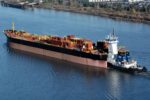
The Chinese-flagged Jin Zhou Wan, for example, made multiple domestic voyages carrying asphalt. MARAD records included a May movement of about 72,843 barrels of bitumen from Harvey, Louisiana, to New Haven, Connecticut, and a June movement of about 71,411 barrels of asphalt from Paulsboro, New Jersey, to Baltimore.
The American Waterways Operators has argued that domestic barge operators had the capacity to move such cargoes and has cited the vessel, which is connected to state-owned COSCO Shipping, as evidence of how broadly the waiver was being used.
National Defense Justifications Questioned
The larger issue is not whether a particular cargo such as fuel, fertilizer or asphalt can ultimately have national-security implications. It is whether each foreign-vessel movement met the statutory requirement that waiving U.S. shipping law was necessary to address an immediate adverse effect on military operations.
An Argus review of 217 movements reported to MARAD found many national-defense explanations used generic language, while 25 apparently retained the placeholder “[cargo]” in the justification submitted for the voyage.
Federal reporting requirements themselves provide unusually detailed information about use of the waiver. Within 10 days after a voyage, vessel owners or operators and waiver requesters must provide MARAD with the vessel and flag, owner and operator, voyage dates, ports, cargo and an explanation of why the waiver was in the interest of national defense. MARAD is required to publish the reports within 48 hours of receiving them.
What those reports do not necessarily establish is whether an available U.S. vessel could have performed the move.
That distinction became central to the Aug. 17 extension.
Before a foreign vessel can now operate under the waiver, the requester must submit a vessel availability request identifying the proposed vessel, cargo, ports, schedule and national-defense justification. MARAD surveys the domestic industry for coastwise-qualified capacity, after which the Department of War determines whether the foreign voyage qualifies.
Early results suggest the availability test is more than a formality.
As of Aug. 21, MARAD had received 27 requests from the Department of War for U.S.-vessel availability determinations, according to AWO. The association said two-thirds of waiver requests processed by the department as of Aug. 20 had been denied.
That raises an obvious question about the preceding five months: How many foreign-vessel movements made under the blanket waiver could have been performed by U.S. vessels if the same availability test had been applied from the beginning?
The public record does not answer it.
FBJNA asked MARAD for information on how vessel availability and national-defense necessity were evaluated under the earlier waiver and for clarification of its findings under the new availability process. MARAD did not respond before publication.
The waiver was initially adopted amid the disruption to energy markets resulting from the conflict with Iran. Supporters argued that allowing foreign vessels into domestic trades could improve fuel distribution and ease price pressure.
But evidence of a significant consumer-price effect has been limited. A Reuters analysis in May found that about 10 million barrels had moved on 50 waiver shipments but that the volumes represented a small fraction of U.S. consumption and had produced limited impact on gasoline prices.
AWO opposed the latest extension, although it welcomed the addition of vessel-availability reviews and the narrower commodity scope. The organization argues the previous waiver was not driven by military requirements and allowed foreign operators to take work that could have remained in the U.S. domestic fleet.
The latest rules at least establish a mechanism for testing that contention before a voyage occurs.
They also expose the central unresolved issue created by the earlier waiver. Congress established a national-defense exception to U.S. coastwise shipping law, not a general exemption based on transportation cost, commercial convenience or commodity availability.
After hundreds of foreign-vessel movements, the question is therefore no longer simply whether the Jones Act waiver helped move cargo.
It is how many of those voyages actually required a waiver at all.
Tags: Jones Act, US Maritime Administration