






Archives
Feature, Freight News, Logistics, Sea
Guinea Iron Ore Exports Lift Capesize Demand
[ November 20, 2026 // Gary Burrows ]Guinea emerged as the world’s third-largest iron ore exporter in October as production from the Simandou mining complex increased, according to BIMCO.
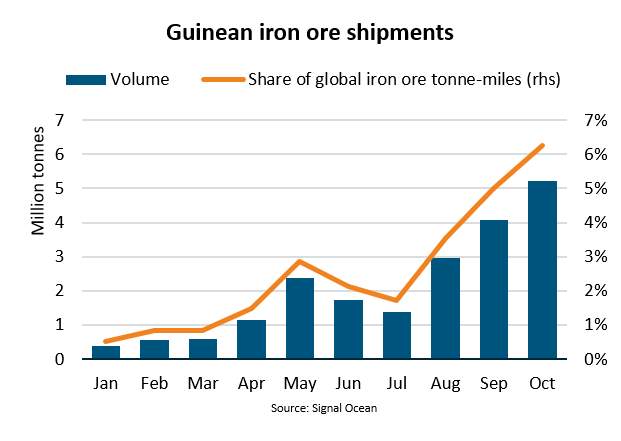
The West African country exported more than 5 million tonnes during the month, representing 3 percent of global iron ore shipments. Exports exceeded 22 million tonnes during the first 10 months of 2026, surpassing initial industry projections of about 20 million tonnes for the full year.
Mining operations at Simandou began in December 2025. The project, located in southeastern Guinea, contains one of the world’s largest deposits of high-grade iron ore and is expected eventually to support annual production of about 120 million tonnes.
October exports were already equivalent to approximately half the project’s planned monthly capacity, although BIMCO said the timing of the full production ramp-up remains uncertain.
The additional cargo is especially significant for the Capesize market because Guinean iron ore shipments travel 88 percent farther than the average iron ore movement. Guinea consequently accounted for 6 percent of global iron ore tonne-mile demand in October despite representing only 3 percent of cargo volume.
“Increase in Guinean shipments contributed to a 2 percent year-over-year increase in global iron ore tonne-miles between January and October, despite stagnant cargo volumes,” said Filipe Gouveia, shipping analysis manager at BIMCO.
Almost all Guinean iron ore shipped this year has moved to China. The country combines imported high-grade ore with generally lower-grade domestic production to supply its steel industry.
Chinese steel production declined 3 percent year over year during the first 10 months of 2026 amid weaker demand, while its iron ore imports increased 1 percent. BIMCO said expanding supply from Guinea and other exporters has placed downward pressure on iron ore prices, making imported material more competitive with Chinese domestic production.
Simandou’s ultimate effect on shipping will depend partly on whether its output supplements or replaces cargo from established exporters. BIMCO estimated that global iron ore tonne-mile demand could increase 13 percent from its 2025 level if Guinean exports reach 120 million tonnes without reducing volumes from other suppliers.
Even if every additional tonne from Guinea displaces an existing shipment, its greater sailing distance could still raise global iron ore tonne-mile demand by about 6 percent.