






Archives
Freight News, Logistics, Sea
CVOW Heralds Offshore Breakbulk Successes
[ May 19, 2026 // Gary Burrows ]The Coastal Virginia Offshore Wind project is one of the largest offshore wind farms in the world, but also one of the most contentious, driving a series of landmark heavy-lift moves after a suspension by the U.S. Interior Department last year was revoked.
Citing “national security concerns,” the project was blocked by the Interior Department in December 2025, only for U.S. District Court for the Eastern District of Virginia to grant a preliminary injunction allowing construction to resume in January. This legal drama was only the latest in a series of challenges facing developers since the start of operations in 2023 at the Portsmouth Marine Terminal (PMT) however all of which have been overcome so far, with the project now nearing completion.
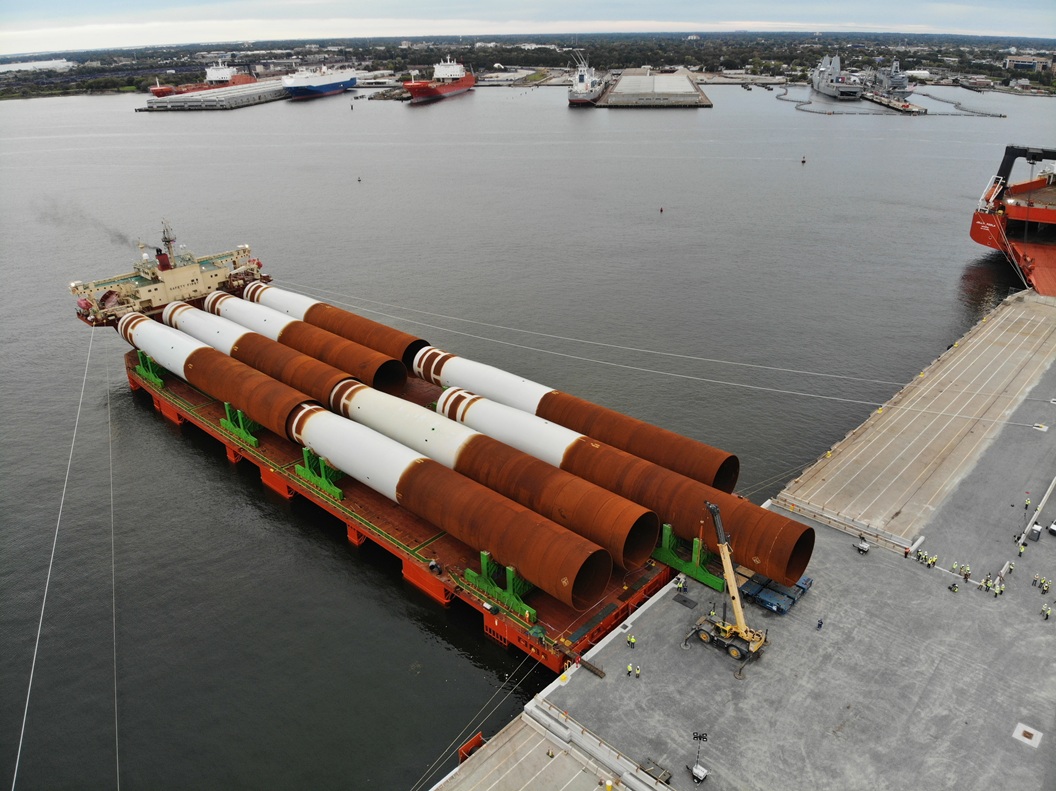
Belgian engineering and transport group Sarens has been at the forefront of breakbulk operations since it was awarded the full onshore marshalling and engineering scope by Virginia International Terminals and has overseen all handling and preparation of the key structural components that form the backbone of the wind farm.
A critical success factor so far has been balancing the need to allow full accessibility to each monopile at any given time, with the careful control required in positioning each component, to ensure stringent ground-bearing requirements were met.
“This innovation proved instrumental in maintaining schedule integrity throughout the project,” the team explained. “By the end of 2025, Sarens had successfully completed all monopile, template, pin pile, and topside operations on schedule.”
In total, the project involved about 740 SPMT transports and 382 lifts using a CC8800 crawler crane. As of the start of the second quarter, Sarens is now approaching the final phase of its scope, with only ten transition pieces remaining before full completion of load-out activities. This marks the culmination of a complex, multi-year operation that has required continuous alignment between engineering, logistics, and execution teams.
Defining Achievements
in total, the work has included the load-in and load-out of 176 transition pieces using SPMTs, alongside the handling of pin piles, templates, and three offshore substations’ topsides, each weighing approximately 4.000 tonnes.
The first turbine was erected in January, and Dominion Energy, the project’s developer, remains on track for full completion by the end of 2026. CVOW’s progress is particularly notable given the broader U.S. offshore wind landscape, where projects face sudden cancellation, delay, or legal battles.
The deployment of the Charybdis, the first Jones Act-compliant wind turbine installation vessel, has improved Sarens’ breakbulk operations, but also heightened pressure, as the vessel’s high daily charter rates and specialized loading requirements demand a ‘zero-latency’ marshalling strategy at the Portsmouth Marine Terminal to prevent costly offshore idling.
“One of the most defining achievements of the project came in meeting the strict environmental constraints imposed on offshore operations.,” a project team member from Sarens noted. “Due to whale migration regulations, offshore piling activities are restricted between Oct. 31 and May 1 each year [but] through close coordination between onshore and offshore teams, all monopile installations were completed one month ahead of this critical deadline, ensuring uninterrupted progress and safeguarding the overall project timeline.”
Belgian group Sarens provides services, engineering, procurement and construction services for heavy-lift projects worldwide via a network of more than 100 subsidiaries in 54 countries.
Uncertain landscape
Despite the momentum of this landmark project, the U.S. offshore wind industry is navigating a period of uncertainty at present. While projects like CVOW, Revolution Wind (now delivering power to New England), and Vineyard Wind (nearing completion) have overcome legal challenges and resumed operations, others have faltered. TotalEnergies exited the U.S. market entirely after accepting a $1 billion government payout to abandon its leases, and GE Vernova’s turbine blade failures have led to costly lawsuits and delays for Vineyard Wind.
For breakbulk and project cargo specialists, the demand for heavy-lift transport, specialized port infrastructure, and just-in-time logistics remains strong, especially as developers seek to mitigate risks and capitalize on the limited windows for installation between environmental restrictions and political shifts.
Tags: Coastal Virginia Offshore Wind, Sarens, U.S. Interior Department, Virginia International Terminals