







Archives
Feature, Freight News, Logistics, Sea
Carriers Results Show Lower Rates, Higher Risk
[ May 19, 2026 // Gary Burrows ]Three major ocean carriers’ latest results point to a market that is no longer being lifted by pandemic-era pricing, even as geopolitical disruption continues to complicate network planning, costs and customer service.
A.P. Moller-Maersk, Ocean Network Express and Kawasaki Kisen Kaisha, or “K” Line, each reported weaker profitability, but the details show different strategies for weathering the downcycle. The broader lesson for ocean carriers is clear: volume growth alone is not enough when vessel supply is expanding, freight rates are under pressure and geopolitical shocks can reshape networks with little warning.
Maersk’s first-quarter results showed the pressure most directly. Revenue fell 2.6 percent year over year to US$13 billion, while EBITDA dropped to US$1.8 billion from US$2.7 billion. EBIT fell to US$340 million from US$1.3 billion. The company said the decline was driven largely by lower rates in Ocean, only partly offset by stronger volumes in its Ocean, Logistics & Services and Terminals businesses.
The contrast inside Maersk was striking. Ocean volumes rose 9.3 percent, but loaded freight rates fell 14 percent, pushing Ocean EBIT to a US$192 million loss from a US$743 million profit a year earlier. Logistics & Services and Terminals performed better, with Logistics & Services revenue up 8.7 percent and Terminals revenue up 6.7 percent. That underlines the advantage of Maersk’s integrated model: ocean shipping may be cyclical, but terminals and logistics can provide some earnings ballast.
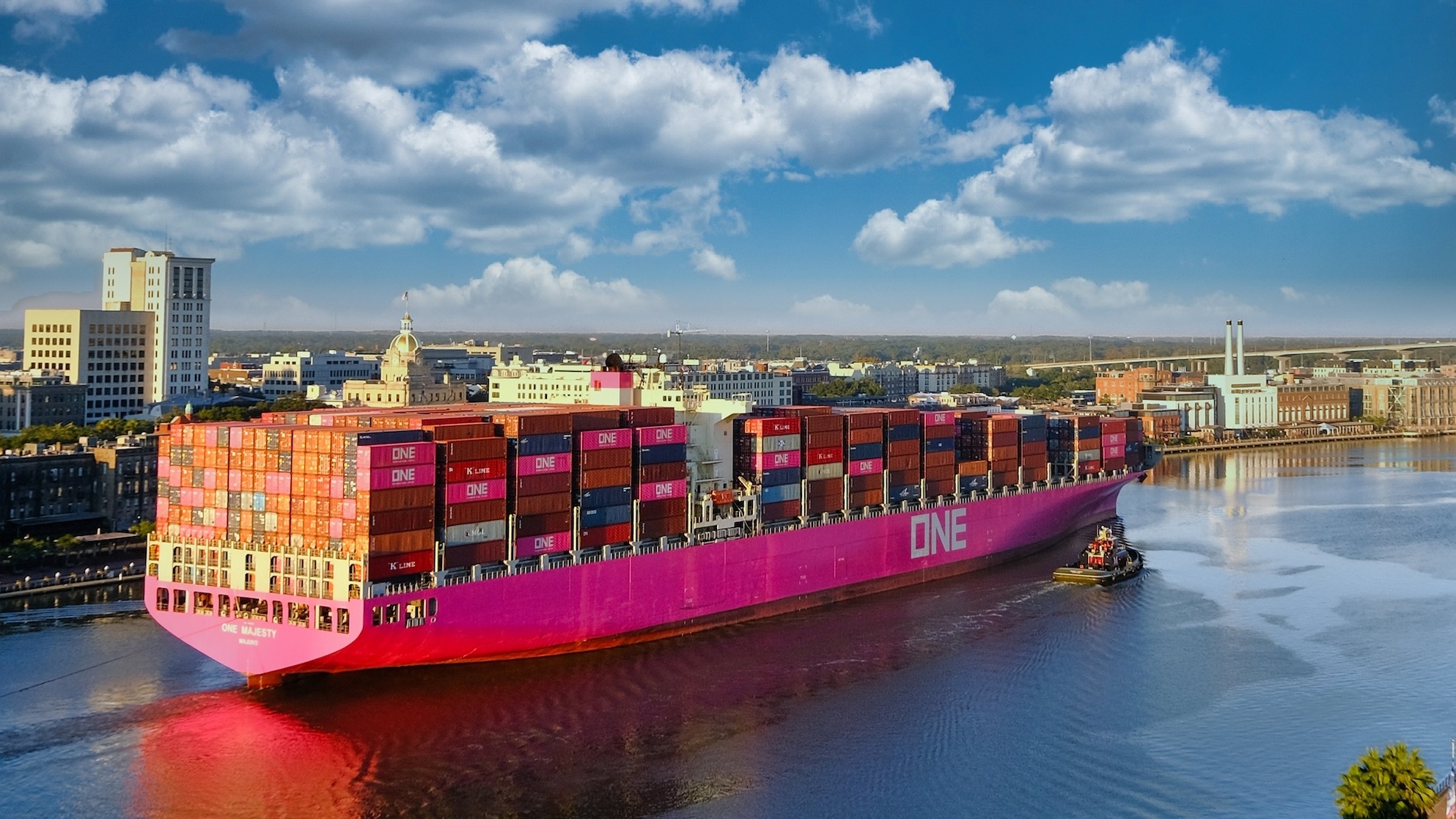
ONE showed a similar rate problem over a longer reporting period. The Singapore-based carrier posted full-year FY2025 profit of US$338 million, down 92 percent from US$4.24 billion a year earlier. Revenue fell 14 percent to US$16.62 billion, while EBITDA dropped 54 percent to US$2.75 billion.
ONE said cargo demand remained subdued, although Asia-Europe demand improved ahead of Lunar New Year, and newbuild deliveries continued to increase market supply.
ONE’s trade-lane data also showed how uneven the market has become. Asia-North America eastbound liftings were essentially flat year over year, while utilization fell to 92 percent from 100 percent. Asia-Europe westbound liftings increased to 1.91 million TEUs from 1.73 million TEUs, but utilization slipped to 89 percent from 95 percent. Freight indexes on both major east-west routes were sharply lower than the prior year.
“K” Line, meanwhile, reported consolidated operating revenues of about US$6.78 billion for the year ended March 31, down 2.8 percent, with operating income down 18.2 percent to about US$560 million and profit attributable to owners of the parent down 56.5 percent to about US$885 million. Its product logistics segment, which includes its equity-method exposure to ONE, saw segment profit fall 69 percent to about US$604 million.
The Japanese carrier’s results show the limits of diversification when container profits normalize. “K” Line said ONE’s revenue and profit fell as average freight rates remained below the previous year, while oversupply from large-scale new vessel deliveries did not improve. Still, its energy resource transport business performed better, supported by mid- and long-term contracts, pointing to the value of stable contracted earnings in volatile markets.
Near term, carriers face a difficult balance. The Middle East conflict had limited impact on first-quarter or fourth-quarter reported results for Maersk and ONE because of timing, but both carriers warned of higher costs, network disruption and uncertainty around the Red Sea, Suez Canal and Strait of Hormuz. Maersk maintained 2026 guidance but said its range reflected overcapacity and different scenarios for reopening key Middle East routes. ONE forecast FY2026 profit of US$300 million, assuming conditions stabilize by summer.
Longer term, the message is less about crisis response and more about structural discipline. The container sector still has a supply problem, and rate recovery will be fragile unless carriers manage capacity, vessel deployment and cost bases carefully. The winners will likely be those with flexible networks, strong terminal or logistics earnings, disciplined capital spending and enough balance-sheet strength to keep investing through the cycle.
For shippers, the results suggest a market that may remain volatile but not uniformly tight. For carriers, they are a reminder that disruption can briefly support rates, but it cannot replace fundamentals. Oversupply, route risk and geopolitical uncertainty are now part of the operating environment, and the industry’s next test will be whether it can preserve service reliability and profitability without relying on another extraordinary freight-rate boom.
OTHER REPORTS:
Taiwan-based ocean carrier Evergreen Marine reported a steep decline in first-quarter earnings as softer container freight rates continued pressuring carrier profitability despite higher cargo volumes.
Evergreen said first-quarter net profit fell about 70 percent year over year to roughly US$264 million, while revenue declined more than 21 percent to US$2.75 billion, according to industry reports and company disclosures.
The results reflect ongoing weakness in global container shipping markets as excess vessel capacity and moderating demand continue weighing on freight rates across major east-west trade lanes.
Industry analysts said the downturn mirrors broader financial pressure facing container lines following the unwinding of pandemic-era freight rate highs. Higher fuel costs tied to Middle East tensions have also added pressure to carrier margins.
German container carrier Hapag-Lloyd reported a first-quarter net loss as weaker freight rates, severe weather disruptions and Middle East instability pressured earnings.
The carrier posted a net loss of 219 million euros (US$257 million) for the quarter, compared with a 446 million euro profit a year earlier. Revenue fell nearly 17 percent to 4.2 billion euros as average freight rates declined 9.5 percent.
Hapag-Lloyd said weather-related port congestion and rerouting tied to the Strait of Hormuz conflict increased operating costs and disrupted supply chains.
Tags: A.P. Moller - Maersk, K Line, Ocean Network Express