







Archives
Freight News, Logistics, Sea
Bulker Building Contracts Drop to 5-year Low
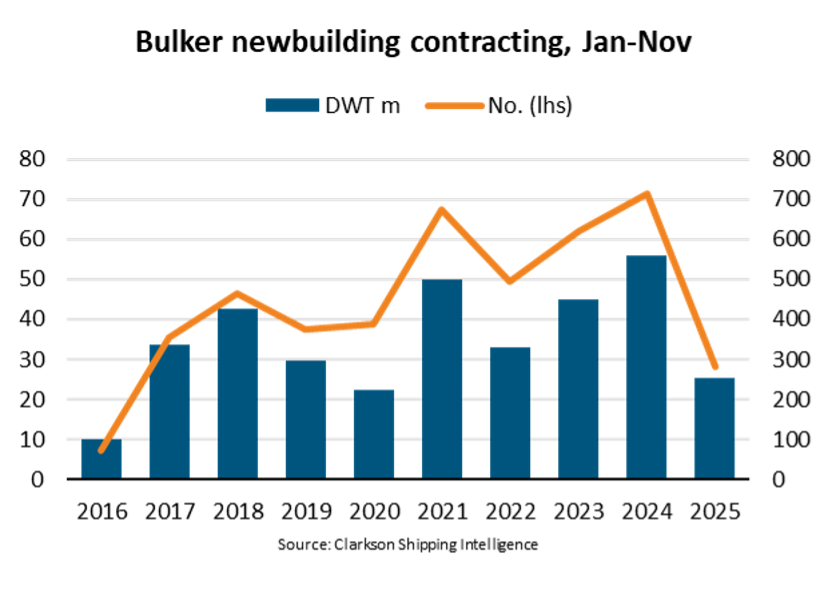
[ December 8, 2025 // Gary Burrows ]Through November the capacity of bulker newbuilding contract fell 54 percent year-over-year to 25 million deadweight tons, its lowest level since 2020, said BIMCO, the Danish shipping association.
The result is the dry bulk orderbook 4 percent lower than a year ago, and accounting for 11 percent of the dry bulk fleet, said Filipe Gouveia, shipping analysis manager at BIMCO.
The number of ships contracted has seen an even steeper decline, 61 percent year-over-year so far in 2025. Only 281 ships have been ordered, the lowest number since 2016. While contracting has fallen across all segments, orders in the capesize segment, which contains the largest ships in the dry bulk fleet, have been comparatively higher.
The outlook for freight rates over the next two years appears strongest for the capesize segment. Cargo demand growth could soften but sailing distances are expected to lengthen, boosting tonne mile demand. Additionally, supply growth is estimated be low amid limited deliveries. Capesize ships face the longest lead times with 77 percent of contracting so far this year scheduled to be delivered after 2027.
Contracting in the supramax and panamax segments has declined significantly, falling 76 percent and 55 percent year over year, respectively. With both segments’ comparatively large orderbooks, ship deliveries are to increase in 2026 and 2027. Their demand outlook appears weak, while the potential of ships returning to the Red Sea poses a further downside risk to demand for these segments. “These factors could lead to weaker freight rates over the next two years, which might be discouraging newbuilding contracting,” Gouveia said.
Chinese shipyards have received 81 percent of new orders in terms of ship capacity, up nine percentage points from 2024, cutting into Japan’s market share. China has thereby remained by far the most dominant shipbuilding nation in the bulk sector in 2025, despite the previous announcement of the now suspended USTR port fees on Chinese built ships. Shipments to or from the U.S. only account for 8 percent of global cargoes, which, paired with several fee exemptions, likely contributed to continued preference for Chinese yards.
One factor supporting newbuilding contracting is a 3 percent drop in prices since the start of 2025, compared to a 4 percent increase in five-year-old second-hand prices. This reflects a strengthening of market conditions and freight rates during the second half of the year. While lower prices could theoretically encourage contracting, lead times for new orders remain high. Therefore, ships ordered today may be delivered under vastly different market conditions.
Tags: BIMCO