







Archives
Feature, Freight News, Logistics
AI, Frontloading Lifts World Trade, WTO
[ October 10, 2025 // Gary Burrows ]Global merchandise trade outpaced first half 2025 expectations, driven by increased spending on AI-related products, a surge in North American imports ahead of tariff hikes, and strong trade among the rest of the world.
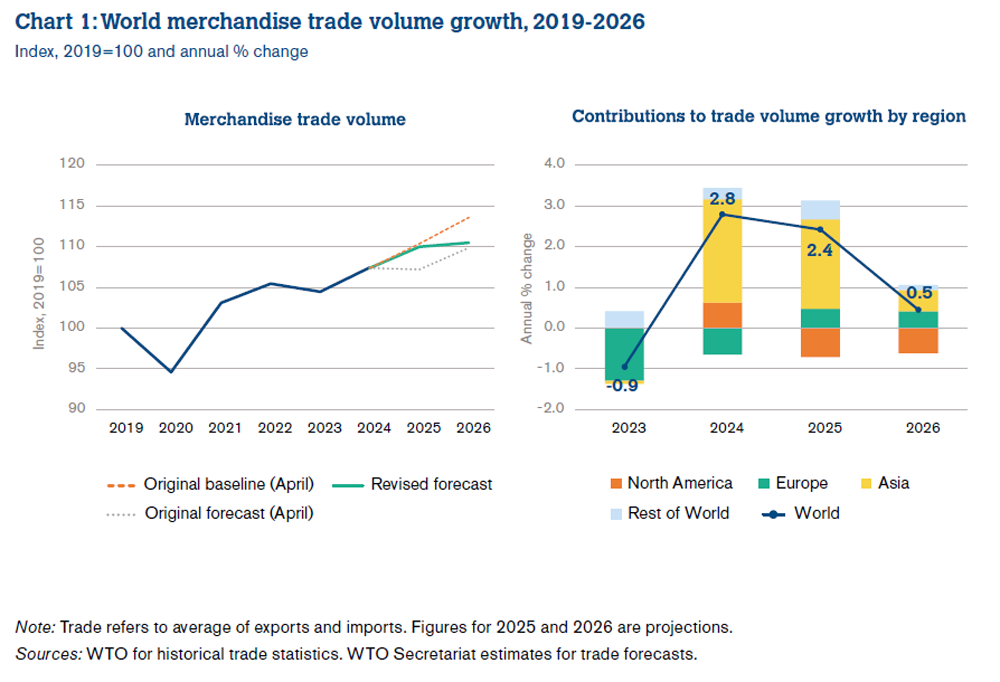
In response, the World Trade Organization economists raised the 2025 merchandise trade growth forecast to 2.4 percent (up from 0.9 percent in August). However, the 2026 projection has been lowered to 0.5 percent (from 1.8 percent). Global services exports growth is expected to slow from 6.8 percent in 2024 to 4.6 percent in 2025 and 4.4 percent in 2026.
In the Oct. 7 update of Global Trade Outlook and Statistics (https://tinyurl.com/423uw7cy), WTO economists provided new analysis on the build-up in inventories in 2025 and the robust trade in artificial intelligence-related goods such as semiconductors, servers and telecommunications equipment. They note, however, that trade growth will likely slow in 2026 as the impact of the cooling global economy and new tariffs set in.
World merchandise trade, as measured by the average of exports and imports, grew 4.9 percent year-on-year in the first half of 2025, the WTO said. The value of world merchandise trade in U.S. dollar terms was up 6 percent year-on-year in the first six months of 2025 following a 2 percent increase in 2024.
Trade growth drivers in the first half included the frontloading of imports in North America and favorable macroeconomic conditions such as disinflation, supportive fiscal policies, and strong growth in emerging markets. Industry reports, including purchasing managers’ indices (PMIs) and national statistics, show rising inventories, with inventories-to-sales ratios in North America increasing in the first half of 2025 across sectors like machinery, motor vehicles, lumber, construction equipment, and non-durable goods.
AI-related goods – including semiconductors, servers and telecommunications equipment – drove nearly half of the overall trade expansion in the first half of the year, rising 20 percent year-on-year in value terms. Trade growth spanned the digital value chain, from raw silicon and specialty gases to devices powering cloud platforms and AI applications.
World merchandise trade volume growth is expected to slow from 2.8 percent in 2024, to 2.4 percent in 2025 and 0.5 percent in 2026. The projection for global GDP growth is 2.7 percent for 2025 and 2.6 percent for 2026. While the 2025 merchandise trade forecast has been revised upwards from the April and August projections, the downgrade for 2026 results in a similar overall impact over the two-year horizon. This indicates that the tariff impact has shifted into 2026, with the slight improvement reflecting that some inventories build up in early 2025 – particularly of durable goods –will not be fully reversed in 2026.
The report also provides an analysis of trade imbalances and limits of trade policy.
Tags: World Trade Organization