








Archives
Feature, Freight News, Logistics, Sea
‘K’ Line Releases $8 Billion Growth Plan
[ November 5, 2026 // Gary Burrows ]Kawasaki Kisen Kaisha (“K” Line) plans to invest approximately US$8 billion (1.25 trillion yen) during the five years through fiscal 2031 as it expands beyond its core ocean transportation businesses into logistics, offshore services and energy supply chains.
The plan was released as “K” Line raised its fiscal 2026 earnings outlook following stronger dry bulk markets and improved containership results.
“K” Line reported first-half operating revenue of US$3.86 billion (602 billion yen), up from US$3.21 billion (500.5 billion yen) a year earlier. Operating income rose to US$329 million (51.2 billion yen) from US$275 million (42.9 billion yen), while ordinary income nearly doubled to US$759 million (118.3 billion yen) from US$382 million (59.6 billion yen). Net income attributable to owners of the parent increased to US$799 million (124.5 billion yen) from US$440 million (68.6 billion yen).
For the full fiscal year ending March 31, “K” Line forecasts revenue of US$7.51 billion (1.17 trillion yen), operating income of US$584 million (91 billion yen) and ordinary income of US$1.22 billion (190 billion yen). The ordinary-income projection is US$353 million (55 billion yen) above its August forecast.
Attributable net income also is projected at US$1.22 billion (190 billion yen), an increase of US$353 million (55 billion yen) from the previous forecast.
“K” Line said firm capesize, panamax and smaller-vessel markets lifted dry bulk earnings during the first half. Containership earnings also increased as disruption in the Middle East and port congestion tightened vessel capacity and supported short-term freight rates.
Those gains were partly offset by weaker car-carrier earnings as Middle East disruption reduced fleet utilization and increased bunker and other operating costs.
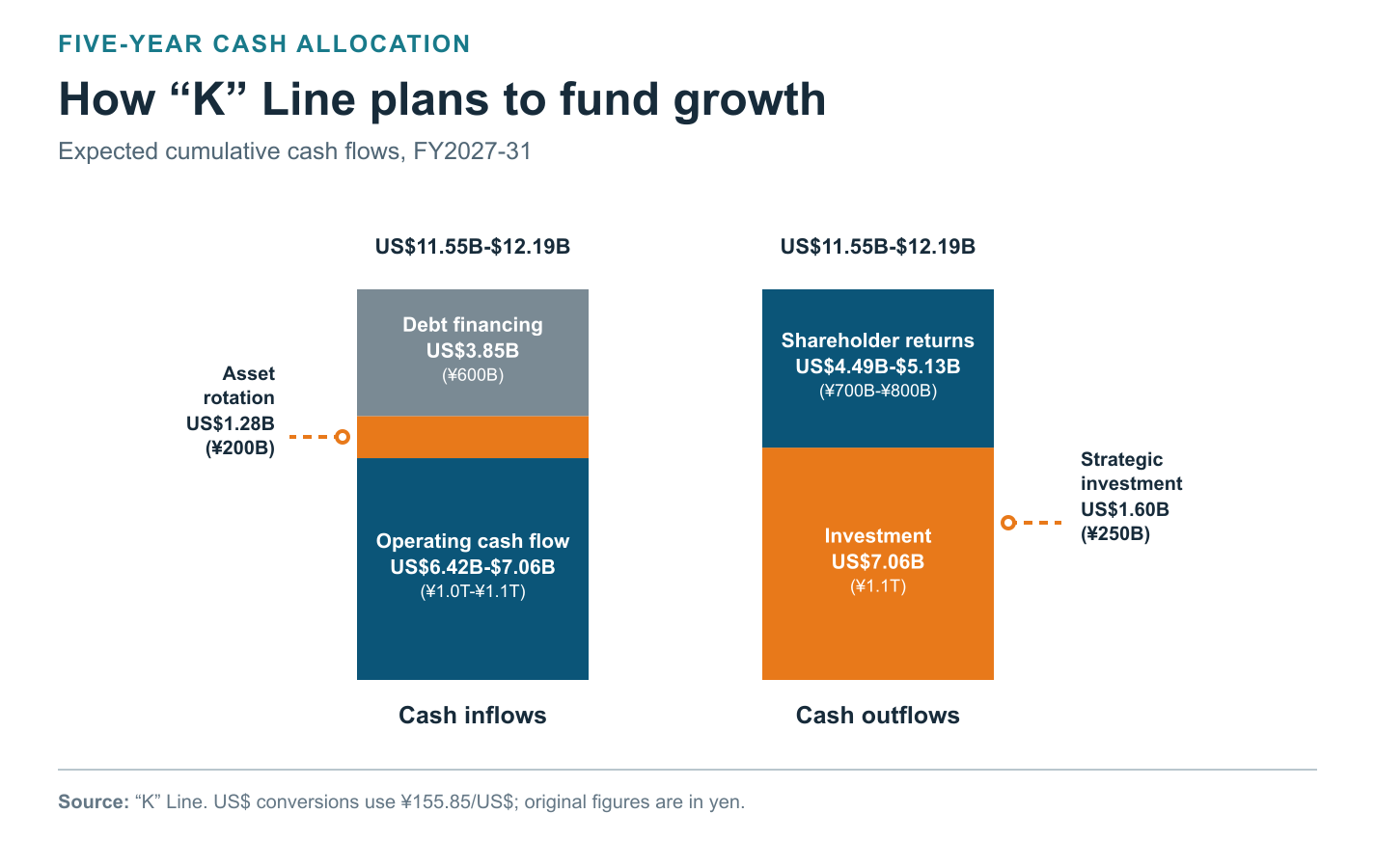
Under its fiscal 2027-31 management plan, “K” Line expects to allocate US$2.89 billion (450 billion yen) to its car-carrier business, US$1.86 billion (290 billion yen) to energy-resource transport, US$1.48 billion (230 billion yen) to dry bulk and US$321 million (50 billion yen) to short-sea shipping, logistics and port operations. Another US$1.6 billion (250 billion yen) is reserved for strategic investments.
The company plans to build businesses adjacent to ocean transportation, including ports and terminals, freight forwarding, warehousing, land transportation, offshore support and new energy supply chains.
“K” Line also intends to use data and artificial intelligence for business automation, vessel-deployment optimization and the development of a company-wide data platform.
By fiscal 2031, the carrier is targeting return on equity of at least 15 percent and return on invested capital of at least 7.5 percent. It expects its own businesses to generate attributable net income of US$770 million (120 billion yen) plus additional returns, compared with a fiscal 2026 forecast of US$578 million (90 billion yen).
“K” Line projects US$6.42 billion to US$7.06 billion (1 trillion to 1.1 trillion yen) in cumulative operating cash flow during the plan period. It plans shareholder returns of US$4.49 billion to US$5.13 billion (700 billion to 800 billion yen) while reducing its equity ratio to approximately 40 percent to 50 percent through investment, financial leverage and shareholder distributions.
Currency conversions are based on “K” Line’s fiscal 2026 assumption of 155.85 yen to US$1.
Tags: Kawasaki Kisen Kaisha Ltd.