








Archives
Feature, Freight News, Logistics, Sea
Bulker Supply to Outpace Demand, BIMCO
[ October 30, 2026 // Gary Burrows ]The dry bulk shipping market is expected to weaken in 2027 as accelerating vessel deliveries outpace demand growth under either of BIMCO’s two Strait of Hormuz scenarios.
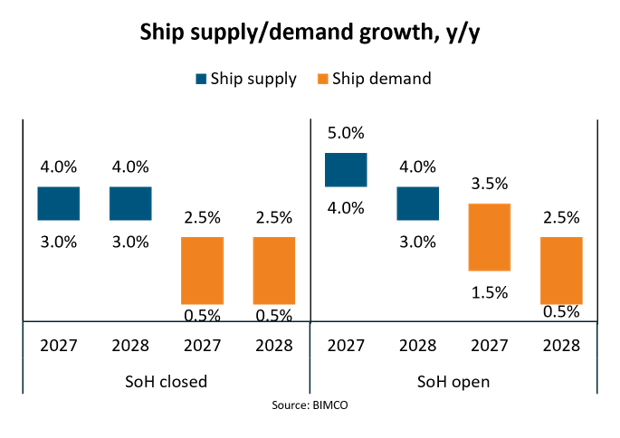
BIMCO forecasts the dry bulk fleet growing 4 percent in both 2027 and 2028, driven largely by increased capesize deliveries. Cargo growth is expected to remain limited, while coal shipments begin declining.
If the Strait of Hormuz remains effectively closed, BIMCO forecasts ship demand growing between 0.5 percent and 2.5 percent in 2027, compared with supply growth of 3 percent to 4 percent.
If vessels can again transit Hormuz freely, demand is forecast to increase between 1.5 percent and 3.5 percent – but supply growth would accelerate to between 4 percent and 5 percent. About 0.5 percent of the dry bulk fleet is assumed to be trapped in the Persian Gulf during 2026 and would return to normal operation if the strait reopened.
BIMCO therefore expects the supply-demand balance to weaken under either scenario, although from what it described as a high baseline.
The association’s October Dry Bulk Shipping Market Overview and Outlook also identifies a full return to Red Sea routing as an additional downside risk not included in either Hormuz scenario. Bulker transits remain about half their 2023 level. BIMCO estimates that a full return could shorten average sailing distances enough to reduce dry bulk tonne-mile demand by about 2 percent.
Dry bulk freight markets have been strong during 2026, with the S&P Global Energy Platts Dry Index increasing 59 percent year over year. Capesizes led the gain, benefiting from limited fleet growth and stronger tonne-mile demand, although capesize rates weakened in recent weeks as more vessels entered ballast.
Forward freight agreements indicate that rates could decline across all dry bulk segments in 2027 while remaining above 2025 levels, BIMCO said.
The dry bulk orderbook reached 169.3 million deadweight tonnes at the end of the third quarter, equivalent to 15.4 percent of the existing fleet. Capesizes accounted for 46 percent of capacity on order, followed by supramaxes at 24 percent and panamaxes at 23 percent.
Deliveries are forecast to reach 51.7 million DWT in 2027 and 54.1 million DWT in 2028. Chinese shipyards secured 90 percent of new dry bulk orders placed during 2026.
Iron ore provides one area of demand support. BIMCO expects shipments to grow between 2 percent and 4.5 percent from 2026 through 2028 as exports increase from Brazil and Africa, particularly Guinea. The resulting South Atlantic-to-Asia movements would lengthen average sailing distances.
Coal presents the opposite trend. BIMCO projects coal shipments declining between 2026 and 2028 under both Hormuz scenarios as electricity generation from renewable sources expands. China has committed to importing at least 10 million tonnes of U.S. coal in both 2027 and 2028, according to the report, but weakening demand in several advanced economies is expected to constrain overall trade.
Grain remains particularly exposed to geopolitical disruption. BIMCO assumes that Russian and Ukrainian grain unable to move during 2026 will instead be exported in 2027. If that cargo remains blocked, total dry bulk volume growth could be as much as 0.5 percentage point weaker than forecast, while grain growth could be as much as 4 percentage points lower.
Fertilizer availability is another concern. About 16 percent of global fertilizer shipments ordinarily originate in the Persian Gulf, and global fertilizer shipments fell 11 percent year over year during the first three quarters of 2026. Continued disruption could reduce agricultural yields and future grain exports.
BIMCO expects dry bulk market conditions to weaken further in 2028 as fleet growth continues and coal volumes decline.

Tags: BIMCO, S&P Global