








Archives
Feature, Freight News, IT Suppliers, Logistics
AI Drives Global Trade to Defy Tariffs, Conflict
[ October 9, 2026 // Gary Burrows ]Global trade is proving more resilient to tariffs and geopolitical disruption than expected, with the artificial intelligence investment boom emerging as a major driver of international goods flows.
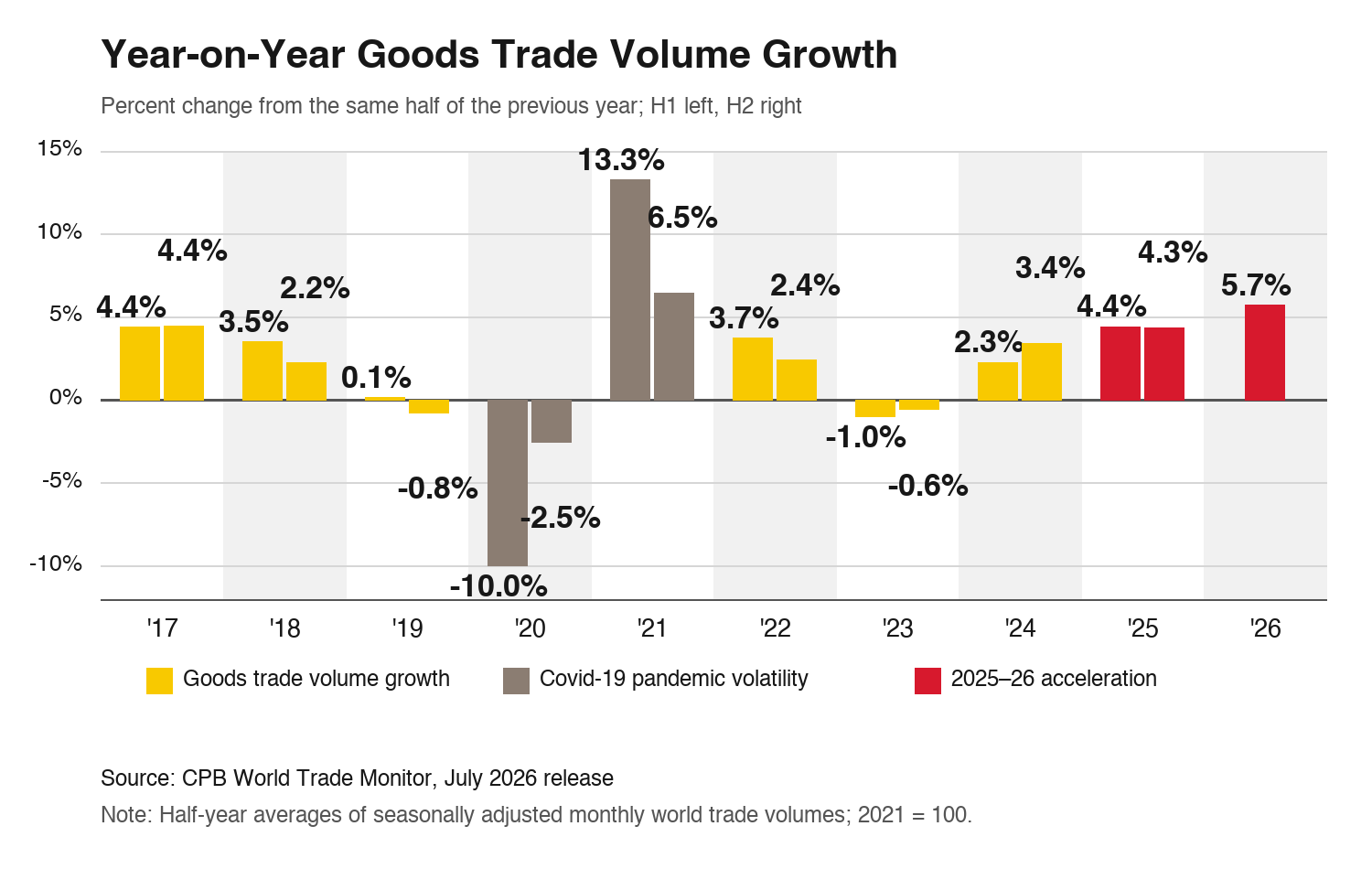
Global goods trade grew faster during the first half of 2026 than in any half-year since 2011, excluding the exceptional rebound following the Covid-19 downturn, according to the October DHL Globalization Tracker, produced by DHL and New York University’s Stern School of Business.
The acceleration came despite U.S. tariff increases and disruption caused by the Iran war and closure of the Strait of Hormuz.
Much of the strength is coming from the infrastructure behind AI. AI-enabling goods accounted for 42 percent of global goods trade growth in 2025 and about 76 percent during the first quarter of 2026, according to WTO and OECD research cited in the report.
Trade in products including semiconductors and data-transmission equipment increased 22 percent in 2025 and accelerated to 42 percent year over year during the first quarter of 2026. Trade in critical minerals, batteries and electric vehicles also expanded rapidly.
“The biggest story in global trade right now is AI, not tariffs,” said John Pearson, CEO of DHL Express.
The strength has changed the trade outlook as well. Global goods trade is now forecast to grow at an annualized rate of 3.4 percent from 2026 through 2029, compared with 2.7 percent during the previous decade. Trade growth is projected to slow from 5.3 percent in 2025 to 4.6 percent this year and 3.6 percent in 2027.
All four forecast sources used to construct the Tracker’s composite outlook now project faster trade growth through 2029 than they did before either the recent U.S. tariff increases or the Iran war.
North America has recorded the largest forecast upgrade since January. The report attributes much of that improvement to the U.S. AI buildout, which has supported imports even as imports of other goods declined.
The findings also challenge the broader assumption that geopolitical fragmentation is producing a widespread retreat from globalization.
The DHL Global Connectedness Index, which measures international relative to domestic activity across trade, capital, information and people flows, reached a record 25.8 percent in 2025. All four categories became more international during the year.
The picture is considerably different in the U.S.-China relationship.
China’s share of U.S. imports peaked at 22 percent in 2017 before falling to 14 percent in 2024, 9 percent in 2025 and 7 percent during the first five months of 2026. But those figures do not capture Chinese components and materials incorporated into products shipped to the U.S. through other countries.
When Chinese value added embedded in those imports is included, the decline in U.S. reliance on China through 2024 was comparatively small, suggesting that part of the apparent decoupling represents a redirection of supply chains through third countries rather than their elimination.
The report finds the broader global effects of U.S.-China decoupling similarly limited. Direct trade between the two countries fell from 3.5 percent of world goods trade at its 2015 peak to 1.6 percent during the first five months of 2026. Close U.S. allies, meanwhile, have largely maintained their economic ties with China.
“The surprise is not only that global trade kept growing through new tariffs and the Iran war,” said Steven A. Altman, director of the DHL Initiative on Globalization at NYU Stern’s Center for the Future of Management. “The outlook is now stronger than it was before either shock.”
The Tracker nevertheless identifies vulnerabilities. The concentration of recent growth in AI-related trade means a slowdown in technology investment could weaken the outlook, while further military escalation and additional trade barriers remain significant risks.
For now, however, the data point toward a global trading system being redirected by technology, tariffs and geopolitics rather than retreating from international commerce.
Tags: DHL, DHL Express, Organization for Economic Cooperation and Development, World Trade Organisation