






Archives
Feature, Freight News, Logistics, People
Global Confidence in US Falls, Pew Research
[ July 17, 2026 // Gary Burrows ]The U.S. is increasingly viewed abroad as an unreliable partner whose foreign policy gives little consideration to other countries’ interests, adding another layer of uncertainty to an international trading system already strained by tariffs and geopolitical conflict.
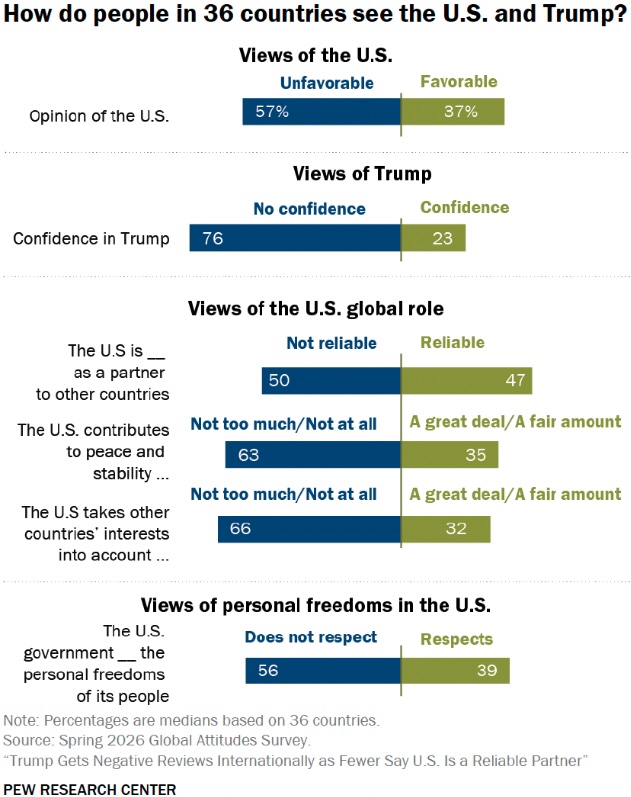
A Pew Research Center survey of 42,151 adults in 36 countries found a median of 37 percent held a favorable view of the U.S., compared with 57 percent who viewed it unfavorably. Favorable ratings fell significantly in 15 of the 24 countries where comparisons with 2025 were available.
The deterioration was particularly notable among several longstanding U.S. economic and security partners. In Canada, the share describing the U.S. as a reliable partner fell from 83 percent in 2022 to 35 percent this year. Pew also reported substantial declines among U.S. partners in the Asia-Pacific region.
The findings do not measure trade or investment decisions directly. They do, however, document weakening confidence in the relationships and institutions that support cross-border commerce, including perceptions of political stability, policy predictability and whether the U.S. will account for the interests of its trading partners.
Across the countries surveyed, a median of 32 percent said the U.S. considers the interests of countries like theirs when making foreign policy decisions. That view declined in 19 of the 22 countries where Pew had comparable results from 2023.
In Germany, the percentage saying the U.S. considers other countries’ interests fell from 60 percent in 2023 to 23 percent this year. Only 10 percent in France and 8 percent in Sweden said U.S. foreign policy takes their countries’ interests into account.
Tariff policy received especially poor ratings in many of the U.S.’ largest trading relationships. Approval of President Donald Trump’s handling of tariffs stood at 27 percent in the United Kingdom, 18 percent in India, 17 percent in Canada, 15 percent in Japan, 14 percent in South Korea, 11 percent in Mexico and 8 percent in Germany.
Those results arrive as importers, exporters and transportation providers attempt to plan around changing tariff regimes, front-loaded shipments and increasingly irregular seasonal cargo patterns.
As reported in Freight Business Journal North America’s July-August peak season feature (available at fbjna.com), importers accelerated some shipments to get ahead of possible tariff changes, while ocean carriers used capacity management and blank sailings to defend rates. Industry participants described a market increasingly shaped by waves of cargo generated by policy deadlines rather than a clearly defined traditional peak season.
The Pew findings suggest the uncertainty surrounding those decisions extends beyond tariff levels themselves. Questions about U.S. reliability and policy continuity could influence how governments and businesses approach sourcing, investment, trade agreements and long-term supply-chain commitments, although the survey does not establish a direct economic effect.
Perceptions of the U.S.’s role in global stability also weakened. A median of 35 percent said the country contributes to international peace and stability, with that share declining in 19 of 22 countries surveyed on the question in both 2023 and 2026. Declines of at least 30 percentage points were recorded in Sweden, the Netherlands, Poland, Canada and Australia.
Confidence in U.S. democratic institutions has also eroded. A median of 39 percent said the U.S. government respects the personal freedoms of its people, while 56 percent said it does not. In 12 of the 13 countries where Pew asked the same question in 2021, the positive response fell by double digits.
The survey was conducted from Feb. 8 through May 13, a period that included the beginning of the U.S.-Israel conflict with Iran. Pew said a separate analysis suggested attitudes toward the U.S. became more negative in some countries as the conflict and the survey period progressed.
For freight markets, the immediate issue is not whether unfavorable opinions translate directly into fewer shipments. It is whether declining trust adds to the risk already being priced into sourcing, routing, inventory and investment decisions.
Tariffs can be calculated. Freight rates can be negotiated. Capacity can be adjusted. The more difficult variable may be confidence that the rules, relationships and commitments underlying international trade will remain intact.
Tags: Pew Research Center