







Archives
Freight News, IT Suppliers, Logistics
TMS More Important Than Ever for Shippers, LSPs
[ September 25, 2025 // Gary Burrows ]A benchmark study found a record 81 percent of some 600 shippers and logistics service providers view transportation management as a differentiator or competitive weapon.
Similarly, those viewing transportation as a basic service or not important dropped to 19 percent, an all-time low since the inception of the study, Descartes Systems Group said in its newly released Ninth Annual Global Transportation Management Benchmarking Survey.
While transportation management systems, or TMS, are increasingly recognized as an essential solution in modern technology environments for shippers and logistics service providers, or LSPs, significant gaps remain in automation and digital maturity, Descartes’ study said.
Descartes and SAPIO Research surveyed 616 participants evenly split between LSPs (brokers, forwarders and third-party logistics providers) and shippers (manufacturers, distributors and retailers) from a range of industries. The goal was to understand how companies view the role of transportation management; uncover which capabilities, technologies and competitive strategies/tactics are having the greatest impact on transportation operations; and provide an outlook on future transportation IT investment. Respondents were based in the U.S., Canada and in Western Europe.
Figure 1. How mature is your company’s transportation technology adoption?
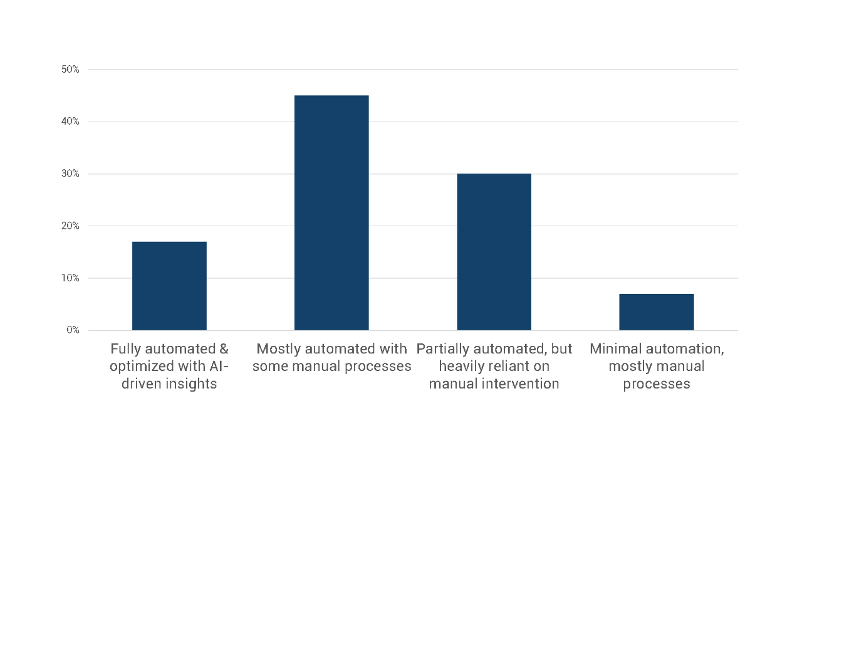
Only 17 percent of respondents report being fully automated, with more than one-third heavily or mostly reliant on manual processes (see Figure 1). This digital gap is especially pronounced between companies with industry leading financial performance (51 percent fully automated processes) and those with below average financial performance (5 percent fully automated processes) who trail significantly in automation, artificial intelligence (AI) adoption and growth expectations.
In terms of adopting generative AI specifically, an overwhelming 96 percent of respondents say they are using it within their operations, with the top three uses cited as data entry (41 percent), route/load optimization (39 percent), and AI-driven freight forecasting and automated load matching/capacity sourcing (both 35 percent) (see Figure 2).
Figure 2. Is your company leveraging generative AI in any of these areas? SOURCE: Descartes
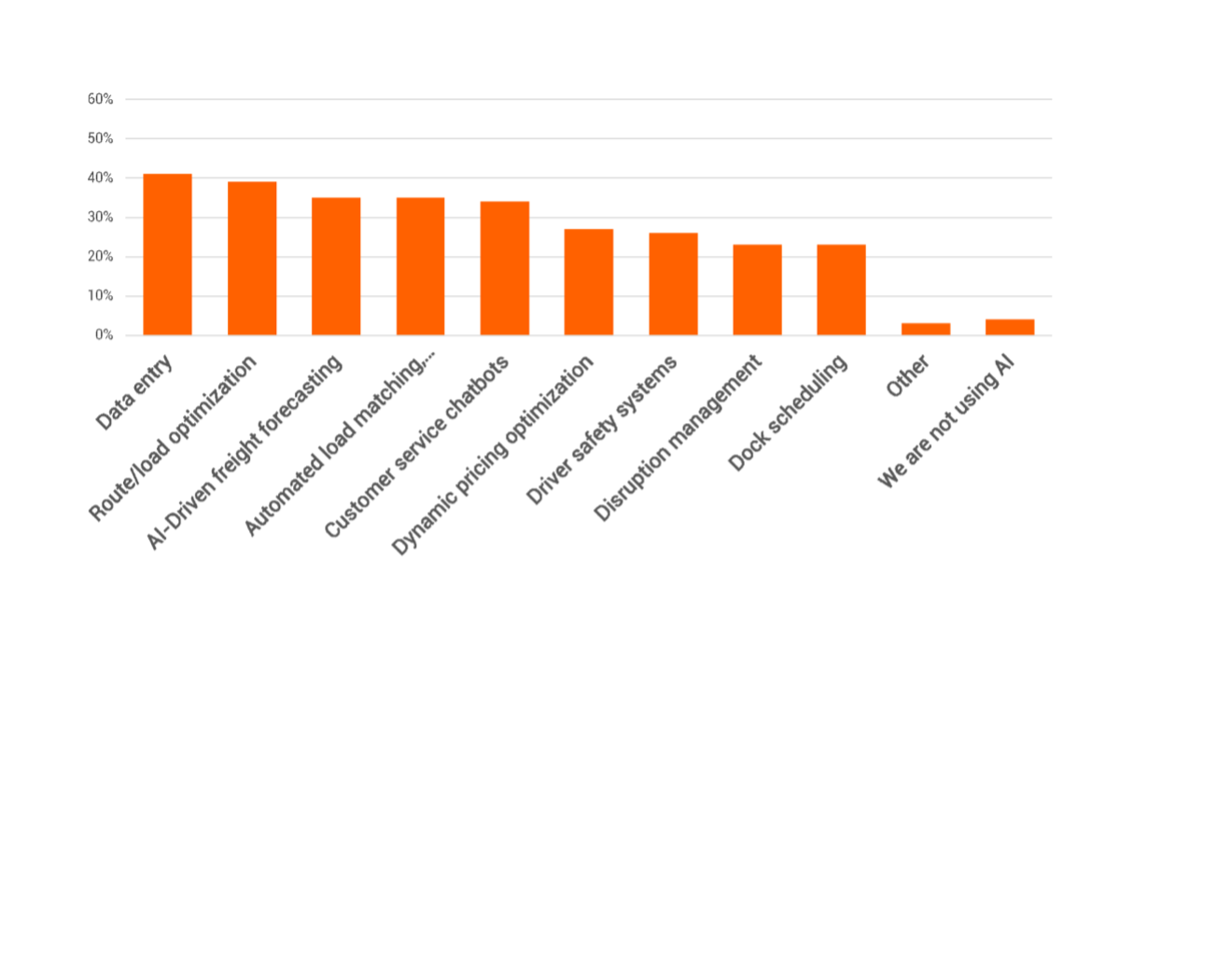
The 4 percent of respondents not using generative AI were much more likely to view transportation management as a necessary evil and more likely to expect limited to no growth over the next two years.
“This year’s survey shows a sector making meaningful progress in elevating transportation from a cost center to a strategic driver of customer value and business growth,” said Mike Hane, director, product marketing, transportation management at Descartes, which provides on-demand, software-as-a-service solutions. “This transition is backed by greater investment in TMS technology, according to study findings, as companies seek to more fully embed automation and AI in transportation management operations to enhance performance and generate value.”
Among other key findings:
• Respondents planning to increase TMS IT spending, with top priorities in performance management, visibility, and fleet routing, 80 percent.
• Carrier monitoring (i.e., insurance, safety, fraud) emerged as a top three TMS capability, with North American respondents prioritizing the capability 7 percent higher than European counterparts.
• Respondents expecting at least 5 percent annual revenue growth in the next two years, 72 percent.
The full report is available at https://tinyurl.com/9ft2ztu4.
Tags: Descartes Systems Group, SAPIO Research, Transportation Management Systems