







Archives
Feature, Freight News, Logistics
Fluor Delivers LNG Canada Export Facility
[ September 12, 2025 // Gary Burrows ]In October 2018, LNG Canada made a final investment decision to build its liquefied natural gas, or LNG, export facility in Kitimat, British Columbia, the largest energy investment in Canadian history.
The LNG export facility – the first of its kind in Canada– facilitates the safe movement and handling of up to 14 million tons of Canada’s surplus LNG to help meet global energy demands.
Located on Canada’s West Coast, the LNG Canada facility benefits from abundant, low-cost natural gas and an ice-free harbor.
LNG Canada is a joint venture comprising Shell (40 percent), PETRONAS (25 percent), PetroChina (15 percent), Mitsubishi Corp. (15 percent) and KOGAS (5 percent).
The facility positions Canada as a major supplier of lower carbon natural gas to global markets and will operate under a 40-year license.
Fluor’s joint venture partnership with JGC Corp. delivered multiple aspects of this project, including engineering, procurement, fabrication and delivery of modules, and construction of the project’s infrastructure and utilities, marine structures and LNG storage tank.
Fluor’s history of successful Canadian projects stretches back to 1945, when it broke ground on a refinery expansion in British Columbia. Fluor and JGC began site activities in 2018, and the first product was exported in 2025.
In August 2025, Fluor announced the joint venture had been awarded the contract to update the front-end engineering and design for a proposed Phase 2 expansion to boost the facility’s processing, storage and shipping capabilities.
The design of the facility met some of the strictest regulatory standards in the world for safety, sustainability and environmental protection. In consultation with First Nations, work activities were planned to minimize potential impacts to the local environment.
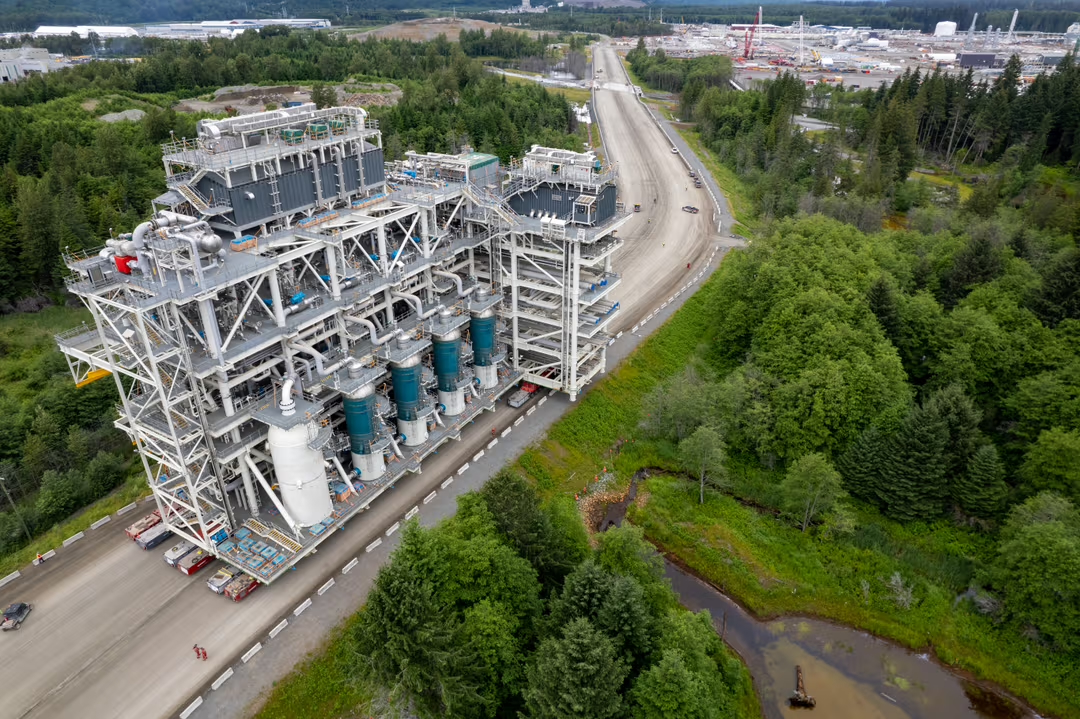
The project utilized a cost-effective modular construction approach. Large and complex modules were assembled by several existing fabrication yards and transported to the project site via water, minimizing construction congestion and disruptions in the community.
In March 2022, the first major module, measuring 145 feet tall and weighing more than 5,000 tons, was received at the site. The final module arrived in July 2023, completing the module fabrication program. Overall, more than 215 modules of varying sizes were received and set at the project site. The largest modules measured approximately 45 meters wide, 75 meters deep and 47 meters in height. The project also included the construction of the world’s second-largest LNG storage tank – 56 meters high, 75 meters in diameter with a volume of more than 225,000 cubic meters.
In the summer 2024, the first train moved closer to completion with the final weld, marking a pivotal moment in the construction of one of Canada’s largest energy projects. The final weld took 48 hours of continuous work from teams of welders working in shifts. More than 380 pipe welders had worked on the project since construction began in 2018.
The joint venture focused on hiring locally and throughout British Columbia and Canada. More than 4,500 jobs were created at the peak of construction, which required about 7,000 to 7,500 workers due to the shift work nature of employment.
Workforce development and training programs were developed for local community members, with a focus on developing positions for traditionally underrepresented individuals and groups. Contracting and procurement opportunities were also provided for First Nations and local businesses.
Tags: Fluor, LNG Canada, PETRONAS