







Archives
Feature, Freight News, Road, Sea
DOT Grants Advance Port of Coos Bay’s PCIP
[ August 15, 2025 // Gary Burrows ]The Oregon Port of Coos Bay has executed two major federal grant agreements with the U.S. Department of Transportation, a pivotal milestone for the Pacific Coast Intermodal Port, or PCIP, and reinforcing the growing momentum behind the region’s significant infrastructure efforts.
The executed grants – awarded through the Federal Railroad Administration’s Consolidated Rail Infrastructure and Safety Improvements, or CRISI; and Railroad Crossing Elimination (RCE) programs – unlock more than US$33 million in federal investment for early-phase work that will modernize rail infrastructure and improve public safety.
Combined with nearly US$21 million in matching funds, these commitments lay critical groundwork for construction and set the stage for development of the modern terminal on Oregon’s South Coast.
“This is a transformational moment, not just for our region, but for the way goods move across the country,” said Melissa Cribbins, executive director of the PCIP project. “With key federal approvals now in place, we are moving toward construction – reducing freight congestion, creating new career-path jobs, and unlocking a future of more efficient cargo movement.”
The PCIP is designed around what the project team calls the “three-legged stool”:
• Building a modern, greenfield container terminal on the North Spit of Coos Bay.
• Deepening and widening the Coos Bay Navigation Channel.
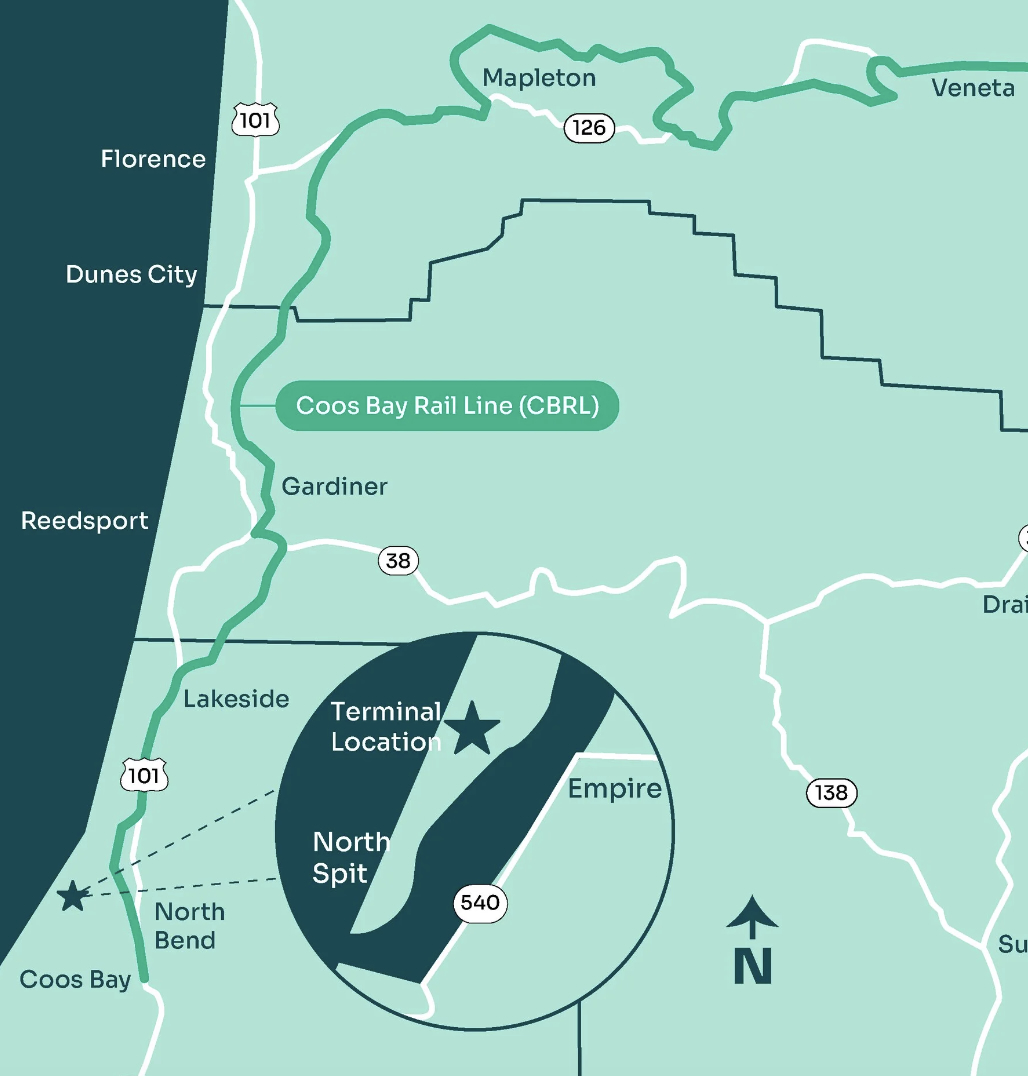
• Comprehensive upgrades to the Coos Bay Rail Line (CBRL), a 115-mile freight corridor linking the port to the Class I rail network in Eugene through the Union Pacific Railyard.
Together, these elements will establish a direct ship-to-rail connection – creating a resilient, low-emission route for containerized exports and imports and positioning Coos Bay as a key logistics gateway for rural and underserved markets across the western states.
The US$29.75 million CRISI grant will fund detailed planning, permitting and engineering for sweeping upgrades to the CBRL – including track replacement, tunnel heightening, bridge rehabilitation and new sidings – along with improvements at Union Pacific’s Eugene yard to support seamless Class I interchange. The US$4 million RCE grant will advance planning for a new overcrossing at OR 38 in Reedsport, which will eliminate a key at-grade crossing and significantly improve community safety and emergency response.
With federal commitments secured and project planning well underway, the Port and its private partner, North Point Development, begins permitting and design.
Chad Meyer, president of NorthPoint Development, said: “We’re committed to working alongside the port and the people of Oregon to deliver a new model for supply chain access – one that’s resilient, sustainable and rooted in this community.”
The PCIP previously secured federal support through the INFRA, CRISI and RCE programs. The port commission’s approval of these grant agreements at their July Commission meeting green lights pre-construction work in earnest– marking an inflection point in the project’s development.
Tags: Pacific Coast Intermodal Port, Port of Coos Bay, US Department of Transportation